The End of March, 2nd year of Genroku, 1689 Kanuma City, Tochigi Prefecture, Oku no Hosomichi
鐘撞かぬ.里は何をか.春の暮 kane tsukanu . sato wa nani o ka . haru no kure When no bell rings What do the villagers do, — Spring Nightfall
Matsuo Basho, Oku no Hosomichi, late Spring 1689
What do you do when no bell rings to tell you its sunset?
After leaving Edo, this was Matsuo Basho’s fifth or sixth stop on his five month long journey, Oku no Hosomichi. Bell ringing at dusk is symbolic in the Buddhist religion. The ringing of the bells (or bell,m depending on the wealth of a village and its temple) is to purify the heart of its 108 earthly desires. Each stop, each village bell, on Basho’s journey, one supposes was shedding one earthly desire. At the very least, the bell told the farmers it was time for rest and relaxation.
Basho had not yet gotten to Nikko. Desiring to see Urami Falls, he took a detour. Indeed, he would take many detours along the way.
鐘撞かぬ.里は何をか.春の暮 kane tsukanu . sato wa nani o ka . haru no kure When no bell rings What do villagers do, — Spring Nightfall
I have two rescue dogs (a bonded pair I call Lucy and Desi) who love to go out the kitchen door and come back in all day. Occasionally, I leave it ajar so they can go out and in on their own. If it is not wide enough, they will sit and stare, for they haven’t learned how to push. Then, to their amazement, there is a “creeack” as the wind opens it wide.
An open door policy is an invitation to flies, as my wife says.
“Cree-ack” was the sound of the wind as it opened the kitchen door
“Whizz” go the flies who furiously flee the swat of the swatter — Bashō no yōna, Spring 2024
Nature’s Sound
“Cree-ack” is a high pitched sound like chalk on a chalkboard. It startles.
Matsuo Basho was captivated by the sounds of Nature. There is the familiar sound of the wind in the trees, the joyful sound of the birds in spring, and the cuckoo that always reminded him of Kyoto (a Proustian moment). Then too there was the famous sound of the water as the frog jumped in the pond — “kerplunk.”
Surely, Matsuo was thinking of himself when he wrote this haiku.
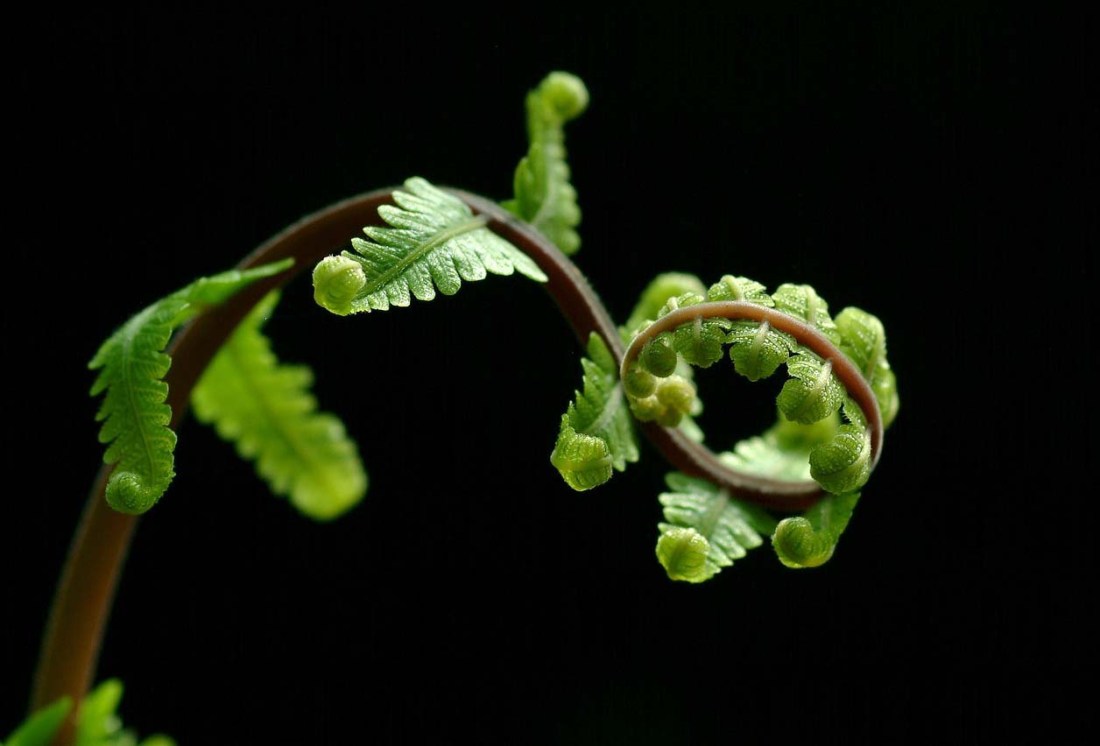
In May it rains and Ferns unfurls in light green color, But when?
五月の雨岩檜葉の緑いつまでぞ satsuki no ame iwahiba no midori itsumade zo
Matsuo Basho, Spring, Summer 1680
The fern becomes a metaphor for Matsuo. In May of 1680, he was not yet “Basho.” Rather, he was, to his friends and students, “Tosei,” the unripe peach. But he was about to change his color, to blossom, to ripen, to become a mature poet. First, to move to Fukagawa, then to travel, and along with the banana plant (basho) beside his simple cottage, become the beloved Basho, by which the world knows him.
But When
“But when?” or “How long?” This question Matsuo asks is personal. How long before Tosei ripens into a mature poet? How long does Matsuo stay in Edo, when other poets have struck out to explore Japan?
Notes on Translation
satsuki (May, or early Summer) no ame iwahiba (moss) nomidori (of green, “midori” is the light green color of early summer, spring) itsumade (until when) zo (emphasis)
Satsuki, fifth month which in the Japanese lunar calendar makes it June or early summer
Iwahiba, a type of fern resembling cypress in appearance that turns brown in winter and with the early rain unfurls into a light green color deepening to dark green as summer comes. It grows in heavily forested mountains and secluded valleys. In drought it closes into a ball.
Itsumade, an interrogative statement meaning “until when.” There is also an old Japanese story of a scavenging bird called “Itsumade” that descends on the dead and cries “itsumade, itsumade” meaning how long until the dead and rotting corpse becomes something else.
February 1688, Genroku 1 Mount Yamato Katsuragi, Nara Prefecture Basho,Age44
In May, on Mount Katsuragi, cherry trees and azalea bushes blossom, pink and red to crimson hues to grace the landscape.
The face of God is graced with grace and flowers
猶みたし 花に明行 神の顔
nao mitashi hana ni ake yuku kami no kao
Matsuo Basho, Notes from My Backpack, Spring 1688
nao (grace) mitashi (fulfill or gratify) hana (flower) ni ake (bright, clear) yuku (likeness) kami no kao (kami, a Shinto God, kao face)
1688
In Japan, it was the beginning of the reign of Emperor Higashiyama.
Japan would not have heard the news, but in 1688 the English Parliament deposed King James VI and replaced him with his daughter Mary and her husband, William of Orange. This would later be called the Glorious Revolution.
Eight years living in a simple cottage in the Fukagawa District outside Edo, a trip now and then, and still, the wanderlust was there. So, in 1688, Basho returned to Ueno (his family home) for the Lunar New Year. As Spring began he returned to Nara prefecture where Saiygo had spent three years as a recluse. He stopped at Mount Yamato Katsuragi to visit the many Shinto shrines and Buddhist temples.
From Nozarashi Kikō, At a Teahouse on Lake Biwa, Jōkyō year 2, Spring, 1685 Basho age 41
At Lake Biwa, at a teahouse, a woman in the shadow of the azalea tearing up codfish, for whom?
In the shade of an azalea a woman tearing up codfish
躑躅生けてその陰に干鱈 割く女 tsutsuji ikete sono kage ni hidara saku onna
Matsuo Basho, Nozarashi Kikō, Spring, 1685
[tsutsuji (azalea) ikete (tearing up, cutting up, arranging) sono (that) kage (shade) ni (in, “sono kage” in the shade) hidara (dried codfish) saku (tear up) onna (woman)]
The Journey
“My mother died.” Basho no doubt had this thought on his mind when he left.
Leaving the basho tree (banana) beside his cottage to Mt. Fuji’s care, Basho set off on a journey that would become his first travelogue. The trip would serve several purposes: Basho’s mother died the year before, it was time to go home and visit; Saiygo the 12th century monk/poet had travelled in and around Mt. Yoshino, and there were friends and acquaintences in and around Kyoto where the poet had spent his early years.
From autumn to winter, to spring again, arriving at Otsu and Karasaki, on the shore of Lake Biwa, resting by the wayside at a tea shop.
Basho explains:
“Stopping at a teahouse for a lunch break, there was a large azalea out front. I couldn’t see well, but in its shade a woman was tearing up dried codfish into strips. Nowadays, cod is a luxury, but in those days, it was a food for the poor, preserved and eaten year round.”
What is left unsaid:
Seeing a woman tearing up codfish is a memory of his own mother feeding her poor family with codfish, which was all they could afford.
Cherry BlossomsinEdo, Spring, 1681-2 Basho, age 37-38
In 17th century Edo, women’s fashions are changing.
Drunk on blossoms a woman in a haori, pointing with a sword
花に酔えり 羽織着て刀 さす女 Hana ni yoeri haori kite katana sasu onna Hana ni ee ri haori kite katana sasu onna
Matsuo Basho, Edo, 1681-2
Translation. Hana (flower, here meaning a cherry blossom) ni (particle to indicate cause) yoeri (to become drunk) haori (a short jacket, women wear over a kimono) kite (wearing) katana (sword) sasu (pointing, stabbing) onna (woman)
Cross-Dressing
Japan was unified under the Tokugawa clan. War was over. Peace was at hand. In Spring, the population turned its attention viewing cherry blossoms and getting sloshed on sake. What one wore was a sign of a person’s status and family background. The haori, a lightweight jacket, became casual wear for samurai warriors and popular attire for up and coming townspeople. Women adopted the style along with the men as it could be worn over a kimono.
But a woman carrying a sword would be quite the site.
Onna-Bugeisha, literally, “female who practices the Art of War.” The 3rd century Empress Jingū, was one of the earliest female warriors. It is likely that Matsuo Basho was familiar with the Tale of Heike which recounts the story of Tomoe Gozen, a female samurai who fought for the Minamoto clan. Basho wrote a haiku about the Genpei War between the Minamoto and the Taira clans.
Gabi Greve and the Japanese site Yamanashi date this haiku to when he was 38 to 40, first to third year of Tenwa, 1681 – 1683. A year before, Matsuo had moved from central Edo to the rural Fukagawa District to take up residence in a simple cottage. A house warming gift of a banana plant (basho) was planted by the front door, and Matsuo had the idea of a new name.
Kanbun year 4, 1664 Matsuo Kinsaku (Basho), age 20 or 21, Kyoto in Spring?
Fading beauty, she blossoms in old age — her memories
姥桜 咲くや 老後の 思い出 uba-sakura saku ya rougo no omoide ubazakura saku ya rougo no omoi-ide
Matsuo Kinsaku (Basho), Spring 1664, age 20 or 21
Notes on Translation
ubazakura (ubasakura) is a particular kind of cherry tree. In Spring, its blossoms appear on leafless branches. It is a metaphor for a woman who is old but still attractive.
uba-sakura (“a faded beauty,” a combination of nursing mother and sakura, cherry blossom) saku (to bloom) ya (emphasis) rougo (old age) no (particle connectining old age and memories) omoide (memory or keepsake)
It had been eight years since our poet (he was not yet called Matsuo Basho) took the momentous step of moving to Edo. Tired of the noise and the crowds, and wanting peace and quiet, he moved to rural Fukagawa, to a simple cottage. There to study and think, to become someone new. The gift of a banana plant (basho) was welcome, but not the silvergrass that grew up alongside it.
by the banana just planted a sign of something disgusting — perhaps silvergrass
ばしょう植ゑてまづ憎む荻の二葉哉 bashō uete mazu nikumu ogi no futaba kana
Matsuo Basho, Fukagawa, Spring 1681
bashō (banana) uete (I planted) mazu (first sign) nikumu (hated, disgusting) ogi (silvergrass) no futaba (sprouting) kana (expressing wonder or puzzlement)
ogi, silvergrass, not the ornamental kind that grows in clumps, but the tall, quickly spreading perennial grass I know as Thompson Grass (other names include knotgrass and eternity grass, because it chokes out other plants and is so hard to get rid of).
By removing himself from the fashionable and noisy Nihonbashi District of Edo, to the remote district of Fukagawa, across the Sumida River, which had yet to be connected to Edo by a bridge. our poet was becoming lonely. He was not married and had no children to distract him. Sure, he had a neighbor, Sora . And there were the steady stream of devoted disciples who crossed the river by boat to get instruction in the art of writing haiku, but, still our poet was without the daily social contact that makes one human.
He read other poets. He studied. One inspiration, the 12th century poet Saigyo, who wandered, was having his effect. Our poet was becoming something, someone else.
But what and who?
The cottage where he lived was the gift of a disciple. So too was a banana plant that our poet planted outside his front door. He watered it, and it took to the soil and the sun, and grew. But in the spring, beside it, there was something emerging.
And one day the poet realized that he was like this banana tree.
Frail and useless, withstanding the sun and rain alike, sometimes battered by the wind, but still there.
Inspired, our poet discarded his old pen name, Tosei, meaning ‘unripe peach.’ After all, he had taken that name, inspired by the Tang poet who inspired him with his short four line verses, Li Bai.
Thus, he emerged from his long slumber and took a new name.
Becoming Matsuo Basho.
Note. Some sources date this haiku to 1680 when our poet first moved to the cottage in Fukagawa. But the move took place late in 1680. In winter.
Winters in Tokyo are sunny but dry, and frost free days don’t come until February. That would be a good time to plant a banana plant. And in March, the hated Silvergrass would appear. Basho’s new cottage was close to the Sumida River, and suitable, if not perfect for the annoying Silvergrass.
let your heart go forth with a flower blossom and one set of begging bowls
この心 . 推せよ花に . 五器一具 kono kokoro / suiseyo hana ni / goki ichigu
Matsuo Basho, Spring, 1692
Basho’s Cottage
By the Spring of 1692, Matsuo Basho was nearing the end of his life. He was, most sources agree, back home in Fukagawa caring for his sick nephew Toin and Toin’s wife. Now and then visitors came by to reminisce. It had been two years since Basho’s own well known journey into Japan’s northern interior (Oku no Hosomichi). Perhaps a friend was following in Basho’s footsteps and this was Basho’s parting gift.
kono kokoru (この心), the English translation may be as simple as an affectionate way of saying “this” or “your heart.”
suiseyeo (推せよ), by itself, 推, has a meaning that is unclear to me, perhaps meaning think, talk, conjecture (Google Translate first says “push”), and せよ, meaning “let us.” Combined with hana, flower, one possibly gets the idea of a monk carrying a lotus flower and his set bowls for his daily meal.
goki ichugu, a set of bowls carried by a monk, one for tea or soup, the other for begging. Goki refers to its deep, flared shape that made it suitable for liquids. Goki, elsewhere implies expressing respect. As ichu means “one” and gu refers to a “tool” or “means to,” ichugu may have the underlying meaning of how to live one’s life, that is, simply, like a monk.
Note. Other translations of this haiku may differ. Sometimes I feel like one of Buddha’s blind men in a tent hearing the words of the haiku (or grabbing parts of an elephant) feeling something different from the rest.
If it was still January, then Spring was early for the budding poet. For the Lunar New Year took place on February the 8th.
This haiku, like many others that I have translated, comes back again and again, year after year, like Spring, then gone.
This is the first known haiku by the poet who would one day become Matsuo Basho. It was written in the Spring of 1663. The young poet was then a servant to his samurai master, Tōdō Yoshitada.
One has to ask …
The Japanese, like the Chinese (and not unlike the ancient Egyptians), used a lunar calendar to calculate when to plant, harvest, and celebrate the cycles of the year. Already, the young poet who would become Matsuo Basho was
Spring, by Oriental reckoning, begins in February when it is still very cold, but the first signs of Spring can be seen in a few blades of green grass that sprout, the swelling buds on trees, and a warm breeze.




 matsuo-basho-haiku