Climbing Long’s Peak

Once on a trip to Estes Park, a friend and I camped below Longs Peak (a “fourteener” located in the Rocky Mountain National Park), having decided on the spur of the moment to make the long climb to the top. It was summer, the evening was cool. It is hard to ignore, he snores. He slept in a one man tent, I crosswise and bent in the car. The stars filled the night sky, and the Milky Way rose behind the peak we hoped to climb the next day.

Unprepared, ill-equipped, we didn’t make it all the way, but had a great time. P.S. a better climber started us out, illuminating the pathway with a headlamp that he wisely brought.

a mountain path

Some thoughts:

Nightfall
Too Dark to Read,
To Bed

A fool
Climbs Mt. Long
Not at all

In Darkness,
With trust in the Buddha,
I start, I stumble, I fall

One can ride horses along the trails on the mountainside. When the sun rose, we saw a few horses roaming freely on the range. One horse had only three legs.

A three legged horse
On the mountainside

Climbs better than most

In the Summer Sun
Snow melts, water gathers
A cold stream

There is still snow at the highest elevations, even in July. The summer sun melts the snow forming narrow streams. One often stops to wash the face and hands with the cold water. Then one moves on, admiring a wildflower that grows nearby.

mountain crocus

1685 (year of Jōkyō, 貞享)

The following haiku is from Basho’s Journal of Bleached Bones (Nozarashi Kiko, 野ざらし紀行). This travelogue covered a trip that began in the fall of 1684 and ended the next spring. Basho traveled from Edo to Iga Ueno, his birthplace. After paying respects to his mother who had died the year before, he traveled to Kamigata (an are encompassing Kyoto, Kobe, and Osaka). Coming along a mountain path, Matsuo Basho spied a mountain violet (sumiregusa). This dainty purple flower with its heart shaped leaves has no smell, but it is charming nevertheless, being one of the earliest flowers to blossom in spring.

coming along a mountain path,
somehow so charming
– a wild violet

山路来て    何やらゆかし   すみれ草
yamaji kite/  namiyara yukashi/   sumiregusa

[ゆかし, yukashi meaning charming, endearing, or moving. This haiku inspired Enya to compose a charming song in Japanese called Sumiregusa.]

My thoughts is this:

A tiny mountain flower
Don’t pick this jewel
Just admire

Having reached the peak of Mt. Long, many climbers quickly descend, either because the peak has become crowded with other climbers, or the time of day is late and the weather uncertain. I think Basho would agree, there is joy in the summit, but the greater joy is in the journey.

It is not the summit
But the Path
I seek

Stage 25, July 1689

By July, 1689, Matsuo Basho and Sora had reached Obanazawa, three months into their Journey to the Northern Interior, and ready to rest.

[By Matsuo Basho’s reckoning, according to the Japanese lunar calendar, it was the 5th lunar month (五日, itsuka), from the 17th to the 27th, 1689.]

Basho writes:

In Obanazawa, I met a man called Seifu (清風, a Chinese phrase meaning cool breeze).”


“He is wealthy, yet a man of a samurai mind. He has a deep understanding of the hardships of the wandering journey, for he himself had traveled often to the capital city. He invited me to stay at his place as long as I wished and made me comfortable in every way he could.”

Making coolness
My lodging,
I rest

Yes (Hai), crawl out!
Croaking toad
Under the silk moth hut

The mental image of
Mayahuki (an eye brush)
And Benihana (Safflower, red powder flower)

Safflower, 紅粉の花

Notes on Translation

Obanazawa (尾花沢), literally means the valley of the yellow iris (尾花). The city is located along the Mogami River in central Japan, halfway between Sendai and Sakata (Stages 18 and 31).

In Obanazawa, Matsuo Basho’s host was Seifu (清風), a wealthy merchant and poet of the Danrin school, founded by Nishiyama Sōin (1605 to 1682). Seifu had previously exchanged haiku with Basho and Sora in Edo. Seifu is the Haiku name of Michisuke Suzuki, a safflower wholesaler, thus the third haiku.


Who knows,

Seifu’s kaiku
Not me, not you

Seifu’s haiku
Faded
Like Safflower powder

Bashō no yōna

I have not been able to find any haiku by Michisuke Suzuki, or Seifu. But, there is a Seifu Museum in Obamazawa.

Safflower (紅粉の花, benibana or beni no hana), has been used in Japan as a source for red tint in cosmetics and dye for clothing. The yellow flower contains a concentrated tinge of red.

Watch a short Japanese film on Benihana.

With the July heating up, and the long walk, Basho and Sora were ready for a rest. The WKD Archive site indicates that Basho stayed at a nearby temple and not with Seifu. Perhaps, Seifu was not as “cool” as his name suggests.

From the second haiku, one infers that Basho’s host also maintained a nursery for Silkworm moths. Basho addresses a toad hidden in a Moth hut. It is hot and humid, Basho kindly commands him to crawl out, enjoy the cool, fresh air.

Mayahaki in the third haiku refers to the brush that sweeps the eye with red powder from the Safflower. It is the signature look of the Geisha.

Original Japanese

涼しさを我宿にしてねまる也

suzushisa o waga yado ni shite nemaru nari

這出よかひやが下のひきの声

hai ideyo kaiya ga shita no hiki no koe

まゆはきを俤にして紅粉の花

mayuhaki o omokage ni shite beni no hana

The Signs of Summer, 1678

Seeing fresh green leaves (青葉), hearing the Mountain Cuckoo (山時鳥), and tasting the season’s first Bonito (初鰹, Skipjack Tuna) — these are images that express the feeling of early summer in Edo, 1678, written down by Yamaguchi Sodo (山口素堂).

Picture a bustling, smelly, noisy fish market in Edo’s fashionable Nihonbashi district. Sanpu Sugiyama, the imperial purveyor of fish is there, supervising the sale of fish. Throngs of people have gathered to see the season’s first Bonito catch. The fish are taken from the boats and displayed on fresh green leaves. Cuckoo birds gather about making their distinctive sounds — ka-ka-ka-ka-ka-kow-kow.

Matsuo Basho and Yamaguchi Sodo, fellow poets and friends of Sanpu, are there as well.

Seeing Aoba
Hearing Hototogisu
Tasting
Hatsugatsuo

An eye for green leaves,
The Mountain Cuckoo
The First Bonito

me ni ha aoba / yama hototogisu / hatsu gatsuo

目には青葉山時鳥初鰹

Hiroshige Utagawa (1842-1894), Bonito Fishing

Yamaguchi Sodo

Yamaguchi Sodo (山口素堂, 1642-1716) was a contemporary of Matsuo Basho, who outlived him by almost 20 years. This simple haiku, which is Zen-like in its sparseness, was collected in “Edo Shindo” (New Road in Edo) in 1678.

In 1675, Sodo met Matsuo Basho for the first time in Edo. Sodo took up residence at Shinobazu-no-Ike Pond in Ueno Park, a former temple, near Basho.

This was Basho’s early period, before Basho moved from noisy Edo across the Sumida River to the quiet Fukagawa District. It was there that Basho took up residence in a simple cottage, planted a banana tree (芭蕉, Bashō) next to the cottage, and, in time, became Basho, and the cottage Basho-an.

The two became fast friends. Perhaps it is merely coincidental, but one cannot help but see and hear the similarity between Matsuo Basho‘s name and Hatsu Gatsuo, the last line of the haiku. The word choice is perhaps not entirely coincidental. The person who provided Basho Matsuo with financial help was his pupil, Sanpu Sugiyama, also known as Ichibei Koiya, Edo’s official fish procurer for the Shogunate.

In old Edo, there was a saying:

女房 を 質屋 に 入れて も 食いたい 初鰹

nyōbō wo shichi ni iretemo hatsu-gatsuo,

“I must taste the season’s first bonito, even if I must pawn my wife!”


Tuna Tataki-style

Hatsu-gatsuo is generally prepared tatakistyle, that is — seared on the outside, raw on the inside, then plunged in ice water, patted dry and showered with fresh green herbs, and finally pressed with cracked pepper and roasted garlic.

Nihonbashi district fish market, Hiroshige Utagawa (1842-1894)

Yamadera, #26

Matsuo Basho was well into his trip when he visited mountainous Yamadera, and the Buddhist temple of Risshaku-ji in northern Yamagata Prefecture. This was stage 26 of 43 recorded stops on his Oku no Hosomichi, Journey to the Northern Interior (奥の細道).

Ah, the Quiet, but piercing the Rocks — the Cry of the Cicada

閑けさや 岩にしみいる 蝉の声

Shizukesa ya/ Iwa ni shimiiru/ Semi no koe

Here he climbed over a thousand steps to the temple of Risshaku-ji (立石寺), founded in 860 AD by the priest Ennin, later known as Jikaku Daishi (慈覺大師). Ennin had studied in China during the Tang Dynasty. This was a literary connection for Basho who had an affinity for the Tang poet Du Fu and all poems of the Tang Dynasty.

On his way to the summit, clinging to the steep, forested, rocky mountain side, he composed this haiku.

For Matsuo Basho, I imagine the haiku means that poetry outlives the poet. It echoes down through generations, as solid as rock. This is similar to the Latin phrase Ars longa, vita brevis, which means either “Art lasts long, life is short” or “it takes a lifetime to learn a skill, life is short”.

Notes on Translation

Semi no koe, 蝉の声, the voice of the cicada. Whether the cicada cries or simply speaks, Gentle Reader, I leave to you.

Compare mizuno oto, 水の音, the sound of water. Unlike Matsuo Basho’s well known, old pond — frog jumps — splash, water’s sound, Basho here uses “voice” for “sound”.

Both haiku are good examples of Basho’s focus on wabi-sabi, 侘び 寂び. This Zen Buddhist concept can best be described as simple and quiet, but elegant, finding beauty in life’s imperfections. For example, a furry caterpillar crawls along a branch after having eaten part of a leaf.

Gentle Reader, how do you find beauty in this world?

Yamadera Temple figure

This haiku was previously translated.

Paddling Satchel Creek

Monday morning, mid-June, warm not hot. A kayak trip up Satchel Creek at Lake El Dorado in southeast Kansas. I am alone in the universe.

The regular rhythm of the paddle in the water inspired these thoughts.

Not haiku, but rules are made to be broken, otherwise how would we improve. Hopefully, the verse is Basho-like, Bashō no yōna. But first, a word from the Master:

With awe I beheld
Fresh leaves, green leaves,
Bright in the sunlight. 

— Matsuo Basho, Road to the Deep North

Let’s Start

Satchel Creek starts out wide as it empties into the lake. Then, as it meanders past rocky shoals, it narrows, until finally the kayak bottoms out on the rocks and one can go no further. But that is still a ways off. A Great Heron accompanies me for a while. Along the way are sunken logs and fallen trees. Spider webs catch their prey. Catfish and carp jump out of the water to catch a fly.

The silence of the water and woods,
The stillness of the air
Is everywhere.
Until one feels a gentle breeze,
And hears the flapping wings of a Great Heron
Leading the way

To who knows where

Paddling up Satchel Creek
In a sleek blue kayak
Past sunken logs and fallen trees
Suddenly, a carp
Grasps a floating bug
Slap goes the water

Matsuo Basho began one his famous journey north with this:

Paddling along, silently wondering, where are the turtles resting on logs in the morning sun? Birds call out sweet songs, unseen in the tall trees.

Turtles will sleep ‘til noon,
Oh, how they hate to get up in the morning.

Have you ever heard a Chickadee call,
High up in a tall tree?

Lake El Dorado was created by the US Army Corps of Engineers in 1981. The waters flooded the old town of Chelsea, but its cemetery remains at the north end of the lake. Along the lakeside and up Satchel Creek, flooding left many old trees in the water. Their ghostly gray silhouettes a reminder of what was once woodlands. The first verse mimics Basho’s thoughts of a crow on a withered branch.

On a withered branch
A blue heron keeps watch
Wary of Summer’s strangers

Dead trees like skeletons
Standing in the water
Praying for what?

Water, water everywhere,
And not a drop to think.
A Mulberry tree along the bank,
Its fruit a gift for me…
Thank God

End

Thomas Wolfe famously said, “You can’t go back home again.” Heraclitus said, “You could not step twice into the same rivers.” Do they mean the same thing?

I am back in Wichita.
Why do they say,
You can’t go back home again.
Why does the river flows on and on?

Uncertainty was the reason for this trip. The uncertainty of tomorrow, the uncertainty that keeps eating away at me, that brings me down. And, as I alluded to in my last post, I felt that with travel I could escape the discontent that uncertainty brings. I was surprised to find it waiting there for me.

As Seneca advises, I need a change of soul.

“Are you surprised, as if it were a novelty, that after a long travel and so many changes of scene you have not been able to shake off the gloom and heaviness of your mind? You need a change of soul rather than a change of climate.” Seneca’s Letters from a Stoic, 29.

Matsuo Basho, on the other hand, gives us his own version of the Serenity Prayer:

Every day’s a journey, the journey itself is home.

What’s on my feet?

May 4th, 1689

After crossing the barrier-gate of Shirakawa on their journey north, Basho and Sora entered the Tōhoku region (東北地方) of northern Japan. They were headed to the scenic pine covered Matsushima islands. But first they would arrive in Tōhoku’s largest city, Sendai. They reached Sendai on May the fourth. This was seasonally significant as May the fifth marked the first day of summer on the Japanese lunar calendar.

Basho had so far covered over 200 miles by foot and his sandals were well worn.

In Sendai, Basho attempted to make the acquaintance of a fellow poet, Michikaze Oyodo, who like Basho traveled a lot and was, at the time living in Sendai. Michikaze was gone. Fortune smiled and Basho was taken on a sightseeing tour of the area by a wood block artist Basho identifies as Kaemon.

Basho explains:

“Crossing the Natori River, I entered Sendai on May the fourth, the day when the Japanese customarily throw iris leaves on the roof and pray for good health. Finding an inn, I decided to stay in Sendai for several days. In this city there was a painter by the name of Kaemon, and I made special efforts to meet him for he was reputed to be truly artistic. He took me to various places which I might have missed but for his help. First we went to the plain of Miyagino, where new fields of bush-clover would blossom in autumn. The hills of Tamada, Yokono, and Tsutsuji-ga-oka were covered in blooming white rhododendrons. Then we went into the dark pine woods called Konoshita where sunbeams could not penetrate. This, the darkest spot on the earth, has been the subject of many poems because of its dewiness – for example, one poet says that his lord when entering needs an umbrella to protect him from dew drops.”

We also stopped at the shrines of Yakushido and Tenjin on our way home.

Eventually, the time came for us to say good-bye. And Kaemon gave me his own drawings of Matsushima and Shiogama, as well as two pairs of straw sandals with laces dyed the deep blue of the iris. This last gift clearly testifies to the true artistic nature of this man.

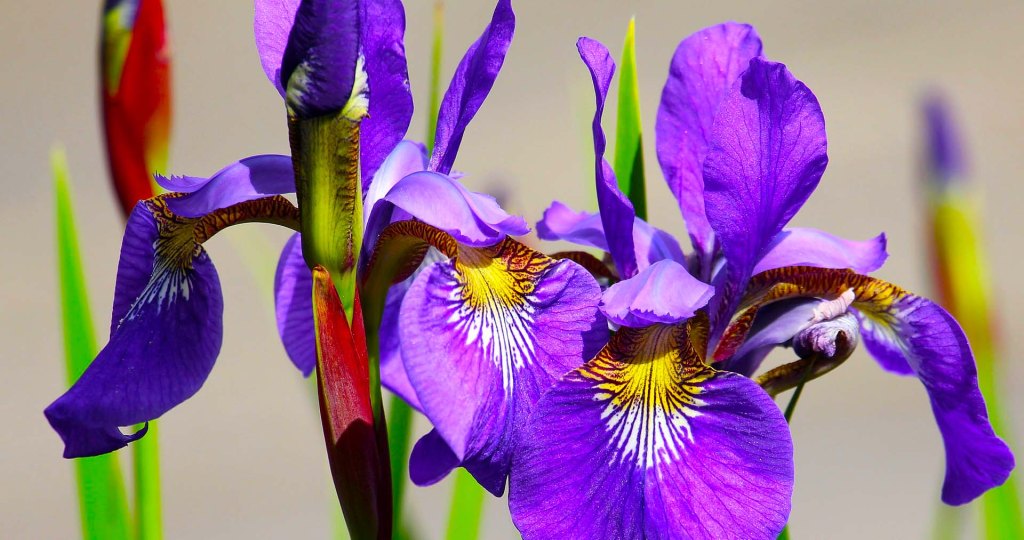
Ah, are they Iris that blossom

On my feet, or —

Sandals laced in blue.

ayamegusa ashi ni musuban waraji no o

あやめ 艸足に結ん 草鞋の緒

Iris blossoms

May, 2021

Ah, the glorious iris —

Now withered and brown,

Nature reclaims

The lunar calendar of 1689 does not match today’s Gregorian calendar of 2021, but it does not seem to be off by much. The iris flowers that graced my yard in early May has fallen, reclaimed by the compost pile.

Ah, the cycle of life. 生命の循環, Seimei no junkan.

Notes on Translation

This is a second look at Basho’s iris haiku, previously posted June 2, 2020.

An in depth look at Basho’s haiku can be found at WKD.

Basho begins his haiku with the Japanese character , A which means Hey! or Ah! (getting someone’s attention or expressing surprise.) But the surprise is that あやめ, Ayame becomes the Iris. Again Basho uses another interjection, , (“nn” sound) before the final question, which is too convey the English idea of “hmmm”.

Kaemon’s identity is revealed in Sora’s Diary. English theories about Kaemon’s name and profession are inconsistent. Terebess, Notes on station 18. Reliable Japanese authorities identify him as Kitanoya Kaemon, a wood block printer and owner of a bookstore. He was a student of the haiku poet Michikaze Oyodo who was then living in Sendai. 仙台, Japanese source. Oyodo Michikaze (大淀 三千風), like Basho, was a prolific haiku writer. In 1682, he published a book called, Matsushima Viewbook, extolling the beauty of the islands.

Night Rain, Bai Juyi

Night Rain

The cricket cried, then stopped to rest

The waning light goes out, now it’s clear.

Outside my window, the night rain lets me know

The Banana leaf speaks first.

Banana Speak

Basho like in its subject matter and concise descriptions, but this poem was actually written by the Chinese Tang poet, Bai Juyi. In fact it mirrors the well known haiku by Basho about the ancient pond, the frog, and the sound of water. Well, as is often said, there is nothing new, just how we say it.

Bai Juyi was a poet of the Tang dynasty. His poems are influenced by his deeply held Buddhist beliefs. These beliefs hold that insight comes from meditation and intuitive thought. Thus, the pitter-patter of the night rain on a banana leaf becomes speech. Unintelligible speech to the untuned human ear, “Banana Speak” to those who know.

Original Pinyin and Chinese

Ye Yu

Zao qiong ti fu xie
Can deng mie you ming.

Ge chuang zhi ye yu
Ba jiao xian you sheng.

夜 雨
早 蛩 啼 复 歇
残 灯 灭 又 明。
隔 窗 知 夜 雨
芭 蕉 先 有 声。

Notes

For an explanation and good story on how Bai Juyi’s poem was falsely attributed to Matsuo Basho, see MISATTRIBUTED TO BASHŌ: BAI JUYI’S “EVENING RAIN”. Okay, so Dave calls it Evening Rain instead of Night Rain. He’s smart and I’m right, and once he looks at translations for the alliterative 雨, Yè yǔ he’ll agree. Indeed, is not only night but night long, as in something occurring during the night. Moreover, in line one, one might argue that our crying cricket has not simply rested, but also gone to bed, which is the literal meaning of 歇, xie. In line two, the sensorily sensitive Bai Juyi makes it clear that all light has gone, evening is done, night has begun. And now it is clear. Clear being the Chinese character 明, which may mean bright or brilliant, but in this case “clear”.

知道了, zhīdàole, Got it!

How Zen!

How Dào! which incidentally rhymes.

More Bai Juyi

For more reading, compare Bai Juyi’s Night Rain with Night Snow by the same poet. Nature speaks!

New Beginnings

Sunday, May 16, 2021

Quoting Matsuo Basho in his Narrow Road to the Deep North (Oku no hosomichi, 奥の細道).

Station 2 – Departure

Early on the morning of March the twenty-seventh I took to the road. Darkness lingered in the sky. The moon was still visible, though gradually thinning away. Mount Fuji’s faint shadow and the cherry blossoms of Ueno and Yanaka bid me a last farewell. My friends had gathered the night before, coming with me on the boat to keep me company for the first few miles. When we got off the boat at Senju, however, the thought of a journey of three thousand miles suddenly seized my heart, and neither the houses of the town nor the faces of my friends could be seen except as a tearful vision in my eyes.

Spring is passing!
Birds are singing, fish weeping
With tearful eyes.

With this verse to commemorate my departure, I began my journey, but lingering thoughts made my steps heavy. Watching friends standing side by side, waving good-bye as long as they could see my back.

Yuku haruya

Spring is passing! Yuku haruya!

The wonderful thing about poetry in verse is that one can read and reread the same poem or the same verse. It is, in a sense a new beginning. It is a chance to start over, although it is on a familiar path, and even so, change directions. Maybe it is a journey into a better lifestyle, with daily exercise and healthier eating.

That new beginning always starts today.

Spring, in verse, in poem,

Perpetually Passing

And yet, it begins anew

Bashō no yōna

Senju

Basho began his journey in the late spring of 1689. His wanderlust lasting over five months — 156 days and nights, to be precise.

The first leg of the journey was by boat from the Fukagawa District where Basho was then living, along the Sumida River, to Senju, today’s Adachi fish market, in the northern part of Edo (Tokyo). From there it was a short walk to the Arakawa River and the bridge that lead north.

Surrounded by the fish mongers and the birds dancing around looking for scraps to eat, Basho began his journey with tearful eyes. He was not quite alone, for Kawai Sora, his neighbor in Fukagawa, would be his companion.

Original Japanese

行く春や 

鳥啼き魚の

目は泪

Yuku haruya

tori naki uo no me

wa namida

Acknowledgements

I do not claim to be original in my translations. Others have come before me. Their translations are equally good or better. Matsuo Basho’s Narrow Road to the Deep North translated by Nobuyuki Yuasa is a good source containing the entire journey and notes. The original Japanese is online. Read Yuasa’s translation in an ongoing single account. See also, Matsuo Basho – WKD Archives, @MatsuoBashoWkdArchives, a Facebook account that contains background information. 

Fried Pies

Deep in the Arbuckle Mountains

Sharing a Fried Coconut Pie

At Turner Falls

My wife and I were driving from Wichita to Dallas for a Mother’s Day Weekend with our daughter. A little more than half way, past Davis, where one enters the Arbuckle Mountains, we stopped to let the dog stretch her legs beside the clear creek. Then, as we were about to leave my wife spotted the sign saying Fried Mountain Pies at a rustic drive up cafe. A half dozen cars and a couple of men carrying brown paper bags told us all that we needed to know.

One was enough for two she said. Sharing is caring I thought.