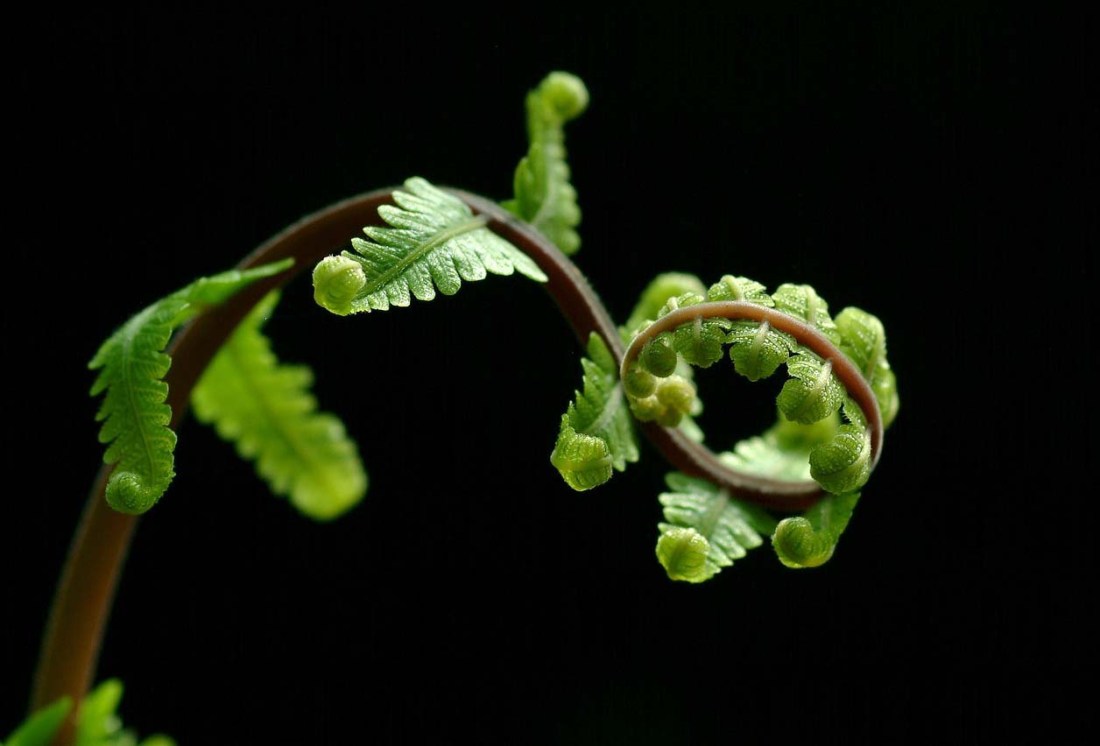
Summer Rain

Basho, age 37
8th year of Enpō, 1680

Surely, Matsuo was thinking of himself when he wrote this haiku.

In May it rains and
Ferns unfurls in light green color,
But when?

五月の雨岩檜葉の緑いつまでぞ
satsuki no ame iwahiba no midori itsumade zo

Matsuo Basho, Spring, Summer 1680

The fern becomes a metaphor for Matsuo. In May of 1680, he was not yet “Basho.” Rather, he was, to his friends and students, “Tosei,” the unripe peach. But he was about to change his color, to blossom, to ripen, to become a mature poet. First, to move to Fukagawa, then to travel, and along with the banana plant (basho) beside his simple cottage, become the beloved Basho, by which the world knows him.

But When

“But when?” or “How long?” This question Matsuo asks is personal. How long before Tosei ripens into a mature poet? How long does Matsuo stay in Edo, when other poets have struck out to explore Japan?

Notes on Translation

satsuki (May, or early Summer) no ame iwahiba (moss) no midori (of green, “midori” is the light green color of early summer, spring) itsumade (until when) zo (emphasis)

Satsuki, fifth month which in the Japanese lunar calendar makes it June or early summer

Iwahiba, a type of fern resembling cypress in appearance that turns brown in winter and with the early rain unfurls into a light green color deepening to dark green as summer comes. It grows in heavily forested mountains and secluded valleys. In drought it closes into a ball.

Itsumade, an interrogative statement meaning “until when.” There is also an old Japanese story of a scavenging bird called “Itsumade” that descends on the dead and cries “itsumade, itsumade” meaning how long until the dead and rotting corpse becomes something else.

岩檜葉, iwahiba

Come out, come out

On the journey north, Oku no Hosomichi
Obanazawa, ancient Dewa Province,
The last week of May, Genroku 2, 1689

這ひ出でよ . 飼屋が下の . 蟇の声
hai ideyo . kaiya ga shita no . hiki no koe
come out, come out!
beneath the shed
you croaking toad

Finding One’s Voice

It is one month into the journey that would become immortalized in Oku no Hosomichi (a tarvelogue on a journey into Japan’s northern interior and along the coast). Matsuo Basho and his traveling companion Sora arrive in Obanazawa where they rest for ten days. Basho hears a croaking toad beneath a shed. Basho commands that he show his face.

But is he speaking of himself?

“Come out, come out where ever you are.”

“Come out,” the good witch Glenda sang in the Wizard of Oz. And so, the Munchkins came out of hiding to meet Dorothy from Kansas.

Playing hide and seek as a kid, there came the point when someone was caught and now, he or she was “it.” So, the call went out, “Come out, come out wherever you are!” and “ollie, ollie, in come free.”

Before his untimely death, Jim Croce, wrote and sang “I’ve got a name,” which also spoke of the croaking toad.

Basho is my name

Matsuo Basho already had a name, Basho. His pen name was taken from the banana tree that grew outside his cottage in the Fukagawa District of Edo. A banana tree, useless for the most part, since it did not bear fruit, nevertheless resilient for it weathered the storms, and occasionally providing shade.

Basho was, still, just finding his voice.

Better yet

Let us go one better. Three years earlier, when his disciples were gathered at his house, Basho wrote a haiku about a frog, a pond, and the sound of water.

An old pond,
a frog jumps in,
ah, the sound of water
Matsuo Basho, Basho-an, Spring 1686

Everyone and everything,
has a voice,
do you know yours?

Plop

Matsuo Basho statue

Not Again

There are endless variations on Matsuo Basho’s frog/pond/sound of water haiku. Here is one more.

古池や蛙飛こむ水のをと

Furu ike ya | In an old pond
kawazu tobikomu | a frog leaps,
mizu no oto | — “Plop!” the sound of water

Matsuo Basho,

Scholars Say

Scholars say this haiku marked Basho’s coming of age. Written in 1686, Basho was now 46 years old, a mature poet, comfortable in his name, Basho, chosen because of the weather beaten banana tree that stood outside his cottage in the Fukagawa District, outside Edo.

Why We Love It

Maybe, the love of the puzzle lies in the fact the frog lets the water talk.

The fascination with Basho’s frog/pond haiku is never ending. A child is delighted with the surprise of walking along a pond and hearing the splash of water. A linguist considers the transformation of action into language, the water speaks. A physicist sees the transformation of matter into energy. A poet finds sonorous, the repetition of sound combined with the clear visual image. The spiritually inclined (both the Buddhist and the Christian, indeed all religion) finds something meaningful in the idea that life is ephemeral like a frog jumping into a pond, making a small splash, and disappearing. Basho could not know, but he had four more short years to live.

The Vocabulary of Water

Onomatopoeia — a word that sounds just like the thing it is describing. From the Greek, literally, ‘name’ plus ‘making’.

One listens to water coming out of the sink or shower; water boiling; water in a gentle creek, or roaring river; the sound of rain on the roof of a car as you drive; water in a puddle as you try to muddle along.

Water speaks in different ways:

babble, bubble, burble, drip, drop, fizz, gargle, gurgle, gush, pitter-patter, plop, pop, ripple, roar, rush, slosh, splish-splash, splosh, splatter, sputter, swish, swirl, swoosh, or tinkle.”

Water speaks but it is also felt, as Helen Keller knew. And if the water is boiling hot, “Y’ouch!”

The Face of God

February 1688, Genroku 1
Mount Yamato Katsuragi
, Nara Prefecture
Basho, Age 44

In May, on Mount Katsuragi, cherry trees and azalea bushes blossom, pink and red to crimson hues to grace the landscape.

The face of God is graced with grace and flowers

猶みたし 花に明行 神の顔

nao mitashi
hana ni ake yuku
kami no kao

Matsuo Basho, Notes from My Backpack, Spring 1688

nao (grace) mitashi (fulfill or gratify)
hana (flower) ni ake (bright, clear) yuku (likeness)
kami no kao (kami, a Shinto God, kao face)

1688

In Japan, it was the beginning of the reign of Emperor Higashiyama.

Japan would not have heard the news, but in 1688 the English Parliament deposed King James VI and replaced him with his daughter Mary and her husband, William of Orange. This would later be called the Glorious Revolution.

Eight years living in a simple cottage in the Fukagawa District outside Edo, a trip now and then, and still, the wanderlust was there. So, in 1688, Basho returned to Ueno (his family home) for the Lunar New Year. As Spring began he returned to Nara prefecture where Saiygo had spent three years as a recluse. He stopped at Mount Yamato Katsuragi to visit the many Shinto shrines and Buddhist temples.

The Face of God, Kami no Kao

A Fine Mist at Mt. Nikko

Along the Oku no Hosomichi
Spring 1689

Here it is half way through May and I find myself wondering where Matsuo Basho is on his journey into Japan’s northern interior (Oku no Hosomichi). Matsuo Basho, no doubt, reckoned by lunar months which makes it difficult pinpoint a place with a specific date.

Today, there is a gentle mist, white clouds, and still the birds are singing. The leaves on the trees are green, not the bright green of early spring, but the full rich green of summer.

Yet, I go back to Mt. Nikko, the fifth stop on the journey known as Oku no Hosomichi. Mt. Nikko (日光), which means bright beams of sunlight.

By Basho’s reckoning, it is the last day of March. He and his traveling companion Sora rested at an inn at the foot of Mt. Niko. There they slept in perfect peace. The next day there was a fine mist, and Basho and Sora climbed the mountain to give homage to its holiest shrine. The site was made famous by Kobo Daishi, founder of Shingon Buddhism. This sect emphasizesthe Hindu concept of dharma, nature’s eternal and inherent reality, the underlying cosmic law revealing right behavior and social order. Do good to be good.

One is always struck with awe when the mist ends and the clouds clear. So too with Basho:

Awe! green leaves, young leaves, sparkling sunlight

あらたふ と青葉若葉の 日の光
ara touto aoba wakaba no hi no hikari

ara (awe) touto (completely, precisely) aoba (fresh leaves) wakaba (new leaves) no hi no (brightness) hikari (light, illumination)

Zen time

On a walk or a run,
Thirty minutes is nothing,
— Time Flies
— Bashō no yōna

Zen is many things to many people, the slowing down of time, the sensation of the world around you, what on might call ultimate reality, the absolute, disconnected from the cell phone, in tune with Nature. On a run at Pawnee Prairie Park in May. The lake is full, beside the lake the yellow Iris are in bloom. In the lake the turtles rest on logs as ducks and their ducklings swim by. And as you near the water’s edge, the frogs click before they jump into the water. Ker-plop!

Mothers Day

Summer, Genroku, 4th year.
May 5, 1691, age 47,
Maybe, Otsu, Japan

Recalling his mother, on Children’s Day?

Seeing a woman wrap sticky rice dumplings in a bamboo leaf and tie it with a string, tucking her hair behind her ear. Did Basho recall his mother?

Holding a dumpling
in one hand, she tucks
her hair behind her ear

粽ゆう 片手にはさむ 額髪
Chimaki yuu katate ni hasamu hitaigami

Matsuo Basho, May 5, 1691

[In Japan, Children’s Day is celebrated on May the 5th. That is close to the celebration of Mother’s Day in America on the second Sunday in May. ]

Summer of 1691

By the summer of 1691, Basho had left the Hut of the Phantom Dwelling, on the shores of Lake Biwa, but he was not yet back in Edo. One imagines he was saying farewells to friends in Otsu or nearby Kyoto before going home to Edo. Home, that is what Edo had become. And the little cottage in Fukagawa, a familiar place to return to.

Three years later, Basho would be dead. He chose to be buried at the Buddhist temple of Gichū-ji (義仲寺) in Otsu.

Notes on Translation

The Japanese traditionally serve and eat Chimaki during the Tango no Sekku (端午の節句, Children’s Day) on the fifth day of May. Another reason to suppose Basho was thinking of his own mother and childhood.

Chimaki (a sticky rice dumpling wrapped in a leaf) yuu (expresses volition, the desire to do something) katate (one hand) ni (particle for indirect objects) hasamu (insert, place) hitaigami (bangs, forehead hair)

A father’s take on making chimaki:

Making Chimaki
Drinking sake and beer,
But, where are the kids?

Bashō no yōna, May, 2024
chimaki, 粽ゆ, zongzi, rice dumpling

Mystery Woman

From Nozarashi Kikō,
At a Teahouse on Lake Biwa,
Jōkyō year 2, Spring, 1685
Basho age 41

At Lake Biwa, at a teahouse, a woman in the shadow of the azalea tearing up codfish, for whom?

In the shade of an azalea
a woman tearing up
codfish

躑躅生けてその陰に干鱈 割く女
tsutsuji ikete sono kage ni hidara saku onna

Matsuo Basho, Nozarashi Kikō, Spring, 1685

[tsutsuji (azalea) ikete (tearing up, cutting up, arranging) sono (that) kage (shade) ni (in, “sono kage” in the shade) hidara (dried codfish) saku (tear up) onna (woman)]

The Journey

“My mother died.” Basho no doubt had this thought on his mind when he left.

Leaving the basho tree (banana) beside his cottage to Mt. Fuji’s care, Basho set off on a journey that would become his first travelogue. The trip would serve several purposes: Basho’s mother died the year before, it was time to go home and visit; Saiygo the 12th century monk/poet had travelled in and around Mt. Yoshino, and there were friends and acquaintences in and around Kyoto where the poet had spent his early years.

From autumn to winter, to spring again, arriving at Otsu and Karasaki, on the shore of Lake Biwa, resting by the wayside at a tea shop.

Basho explains:

“Stopping at a teahouse for a lunch break, there was a large azalea out front. I couldn’t see well, but in its shade a woman was tearing up dried codfish into strips. Nowadays, cod is a luxury, but in those days, it was a food for the poor, preserved and eaten year round.”

What is left unsaid:

Seeing a woman tearing up codfish is a memory of his own mother feeding her poor family with codfish, which was all they could afford.

If one could turn back time …

Fresh Codfish, 鱈, tara