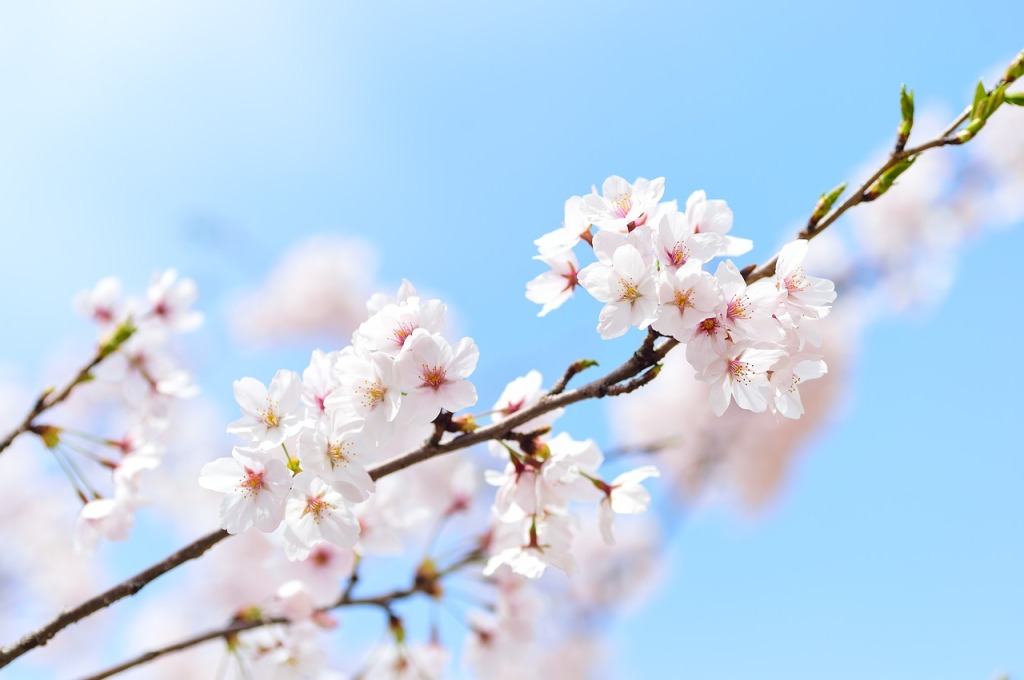
Haru – Spring

Haru, is the Japanese word for Spring.

It is everyone’s favorite season. The willow trees are turning green, the cherry trees blossom, and the birds sing their joyful songs. Let us compare several Spring haiku written decades apart.

Spring budding, 春のつぼみ, harunotsubomi

Haru kaze, 春風

First, 1668, the poet, simply known as Matsuo Munefusa, age 24.

春風に吹き出し笑ふ花もがな
haru kaze ni / fukidashi warau / hana mogana
A Spring breeze is blowing
I’m bursting with laughter
— wishing for flowers

Matsuo Basho, Spring, 1668

Next, Matsuo Basho, now three decades old, has changed from a joyous expectation to a mournful recognition of the passing seasons. Names must have been on his mind. In 1680, he was known as Tosei, the unripe peach. By now, 1684, he had gained a following in Edo. He had moved from the city-center to the more rural Fukagawa District, taken up residence in a simple cottage. A banana plant (Basho) was given to him as a housewarming gift, and this was the inspiration for his new name Matsuo Basho.

春なれや名もなき山の薄霞
haru nare ya / na mo naki yama no / usugasumi
Is it already Spring?
In these nameless mountains
And misty haze

Matsuo Basho, Nozarashi kikō, Spring, 1685

I have included the following (undated) haiku because it speaks of sakura, cherry blossoms, the one true sign of Spring. In Edo (Tokyo), Basho often went to the temple grounds of both Ueno and Asakusa to enjoy the cherry blossoms. Likewise, around Japan and on Lake Biwa there are spectacular displays of the popular spring blossom.

春の夜は桜に明けてしまひけり
haru no yo wa / sakura ni akete / shimai keri
This Spring Night
Ending with dawn
And cherry blossoms

Matsuo Basho, Spring, date unknown

Harusame, 春雨

The following haiku reminds one of Henry Wordsworth Longfellow’s “Into each life some rain must fall.”

Spring 1694, Matsuo Basho, now 51 years old, has returned to his cottage in the Fukagawa District in Edo. Basho wonders what he has to look forward to. Little does he know, it is his last spring. Matsuo Basho will die in November of 1694.

春雨や蜂の巣つたふ屋根の漏り
harusame ya / hachi no su tsutau / yane no mori
Spring rain
Dripping from a wasp nest
And a leaky roof

Matsuo Basho, Spring, 1694

Ukuraina ni heiwa o

The world over one experiences Spring with reverence, with hope for new beginnings, for peace the world over.

For Peace in Ukraine.

ウクライナに平和を.

Birds, busily singing
When, the sun, gloriously rising,
Ah, then, suddenly silent

Bashō no yōna, March, 2022
Bird and Cherry Blossom, III, Hiroshige, 八重桜に鳥, 広重

War

the summer grass
is all that remains
of a soldiers’s dream

the summer grass
the splendid dreams
of Samurai warriors

夏草や 兵どもが 夢の跡

Natsukusa ya/ Tsuwamono domo ga/ Yume no ato

Matsuo Basho, Oku no Hosomichi, 1689

Note. Basho uses Tsuwamono (兵), an old term for a soldier and not Bushi, 武士, samurai warrior.

Ukraine, February 2022

As I write this, Russian military forces are invading the Ukraine. Vladimir Putin who ordered the invasion has bemoaned the collapse of the Soviet Union as the demise of “historical” Russia and dreams of returning the Ukraine to Russian rule.

Ukraine, grass and trees

Baby Sparrow

Sparrow child, Suzume noko

Kobayashi Issa, 小林一茶, (1763 -1828) followed in the footsteps of Matsuo Basho.

雀の子 そこのけそこのけ お馬が通る
Suzume noko/ Sokonoke sokonoke/ Ouma ga tooru

Baby sparrow,
Step aside,
My horse is passing by

The Spring of My Life, Kobayashi Issa, 1819

Version two

Sparrow’s child
Retreat, retreat
Here comes a horse

The Spring of My Life, Kobayashi Issa, 1819

Issa’s Meaning

Step aside.

The internal rhyme alliteration and repetition, Suzume noko, Sokonoke sokonoke, “child, retreat, retreat,” appeal to child and adult alike. That retreat sounds like “tweet” is a bonus for English readers. Issa’s tender haiku advises one to care for the very, very weak.

But, it also serves as a warning — when the big one speaks, little ones should scatter and not be seen. A horse, of course, the all-powerful Shogun.

Baby birds

Yuki, Yuki, Yuki

It snowed last night, several inches, which is unusual in southern Kansas. Snow, snow, snow, let it snow, we used to say as kids, hoping that school would be cancelled, which is what happened today, February, o2, 2022.

Or 2/2/22, a palindrome date.

Looky, looky, looky
Yuki, yuki, yuki
We’re playing hooky

Bashō no yōna, February 2, 2022

Note. Hooky, skipping school without permission. Tom Sawyer and Huck Finn often played hooky.

yuki, snow

Basho on Snow and Winter

From the book Oi no kobumi, Winter 1687-8:

いざ行かむ 雪見にころぶ 所まで
Iza yukan / yukimi ni korobu / tokoro made

Let’s go out
And see the snow
Until we slip and fall.

Matsuo Basho, Oi no kobumi, Winter 1687-8

A child grow up and the snow is not his friend. Still, snow on Mt. Fuji is a thing of beauty.

冬の日や馬上に氷る影法師
fuyu no hi ya / bashō ni kōru / kagebōshi

A winter’s day
me and my shadow
frozen on horseback

一尾根はしぐるる雲か 富士の雪
hito one wa / shigururu kumo ka / Fuji no yuki

over the ridge
Winter showers
is there’s snow on Mount Fuji? 

Matsuo Basho, Oi no kobumi, early Winter 1687-8

Oi no kobumi

In English, Notes from my Knapsack, or Backpack Notes, 笈の小文, October 25, 1687 to June 1688. Matsuo Basho was 44 when he began this round-Robin trip, reciting verse, from Edo to Iga, then Nagoya, to the grand Ise shrine, and from Nara to Otsu, and home again. Like a child going to school he carried a knapsack, oi 笈, usually made of bamboo.

Snow on Mt. Fuji

There are many translations of Matsuo Basho’s haiku. Not surprisingly they do not all agree. Many a slip twixt the cup and the lip, said Robert Burns. In our case, between pen, the word, and the ear.

In the last haiku, being away form Edo, I suspect Matsuo was wondering if the snow had yet appeared at Mt. Fuji. In late fall, snow flurries make their first appearance at Mount Fuji. And, typically, Fuji is snow-capped five months out of the year. Traveling by horse over the hills in a winter storm, wondering is there snow on Mt. Fuji. This question arises because the character か, ka appears prior to snow on Mt. Fuji (shigururu kumo ka / Fuji no yuki).

http://www.metmuseum.org/art/collection/search/56990

Winter Sleet

At this moment, in the Winter of 2022, a snow storm is crossing much of the eastern United States from Boston to Norfolk. Here in the Midwest, the sky is spectacularly clear, China blue, but bitterly cold. While chattering birds look down from the trees above, scampering squirrels hunt for food in my garden.

Matsuo would ask, do birds and squirrels feel the cold, I wonder?

一時雨礫や降つて小石川 
hito shigure/ tsubute ya futte/ Koishikawa

at this moment, it is sleeting
and hailstones are falling all about,
at Koishikawa

Matsuo Basho, 延宝5年, the 5th year of the Enpo era, Edo, 1678-9

To which, Bashō no yōna says:

All about me, it’s sleeting
I’m freezing, only thinking
Fame is fleeting

Bashō no yōna, Wichita, January 2022

To which Matsuo replies:

So is life

Matsuo
Morning after the Snow, Koishikawa, artist Katsushika Hokusai, 1830-2, The Met

Edo, Winter, 1678-9

Matsuo had arrived in Edo, in 1675, seeking fame and fortune as a haiku master. He resided near Edo’s glitzy Nihonbashi District, a country boy in the big city which Edo was becoming. And he was variously employed, making ends meet, while honing his poetic skills. By the winter of 1678-9, he had achieved some recognition.

An admirer of Buddhism, Matsuo would be thinking, fame does not come to all, to those who are lucky, fame is fleeting, for we are only here for a short while — yi shi, 一時.

Fame was in the Future

Matsuo had not, however, taken on the pen-name Matsuo Basho. This would occur after 1680, when he moved to the Fukagawa District of Edo and lived in a simple cottage beside a banana tree given to him by a student. Not had Matsuo taken his journey to the northern interior, which would give him lasting fame in the posthumous publication of Oku no Hosomichi (奥の細道).

For was, now, simply living in the moment, yi shi, 一時.

Notes on Translation

Hito, 一時, Chinese, yi shi, meaning at this time, for the moment, not necessarily a concrete moment, a spiritual one; also a Buddhist term for a period in which one chants a sūtra.

Shigure, 雨, a freezing rain, drizzle, sleet, referring to the rainy season in late fall and early winter.

Futte, 降つて, falling about. Matsuo is also implying that he is about to experience a change of fortunes, either for good or bad.

Koishikawa, a place in Edo (Tokyo), a well known garden constructed in the early Edo period, possessing a view of Mt. Fuji. Koishikawa, meaning small river pebble. Basho’s haiku is a play on words with hail as the small pebble. It is also a Buddhist observation of the insignificance of one moment and one man in the eternity of time and space. Matsuo, at this time was engaged in work on an aqueduct, which may explain the connection with the construction of the garden.

A Japanese point of view of Matsuo Basho.

Squirrels and Robins

Bashō no yōna admires Matsuo Basho’s haiku, but can’t seem to find any haiku on the subject of squirrels or robins. That is a pity as I have an old oak tree in my backyard that has been home to a family of squirrels for as long as I have lived here. And I suppose for many generations before since the tree is well over one hundred years old.

From the tall oak, coppery leaves hang
and acorns fall, gathered by squirrels
for cold days ahead

Bashō no yōna, Winter, January 2022

Often we can go a week or so without rain in Kansas. So, dozens of chattering robins gathered in my yard after I watered the lawn and filled the birdbath. Perched on the side of the birdbath, each robin, 駒鳥 politely dips its beak into the water and raises its head. I am reminded of the Japanese custom of bowing in respect and emotion, ojigi, お辞儀.

I wonder.

Robins at a birdbath
Bobbing heads and drinking,
Saying: Arigato

Bashō no yōna, Wichita, January 2022
a row of oak trees along a path

Another year is gone

Japanese girl at work

Irony — the expression of one’s meaning by using language that normally signifies the opposite. So, the same and not the same. Something else.

年暮れぬ/ 笠きて草鞋/ はきながら

Toshi kurenu/ Kasa kite waraji/ Haki-nagara

Year after year, wearing the same bamboo hat and grass shoes.

Matsuo Basho, 1st year of Jōkyō, 貞享, 1684, Journal of Bleached Bones in a Field
笠, kasa, hat of shaven bamboo

Lost in Translation

HakinagaraHaki, はき – Having the heart to become a champion. Possessing a willingness to confront things. Aspiration. Nagara, ながら, “while,” doing two things simultaneously.

So, Basho is striving to do better while wearing the same old clothes.

Another year has passed my friends, and still we do the same.

Beating on, “boats against the current, borne back ceaselessly into the past.” So concludes Nick Carroway, the narrator in The Great Gatsby. Basho delivers an equally epic line. “Year after year, in the same simple bamboo hat and grass shoes, a little less for the wear, yet, still we willingly confront things, striving to do better.”

Surely a task meant for Sisyphus and each of us. Surely Confucian. Forget Zen mindfulness for a moment. Let’s do better this year.

This haiku was written in Nozarashi Kiko (野ざらし紀行), Journal of Bleached Bones in a Field. This was Basho’s journey home to his birthplace at Iga Ueno, the year after his mother’s death. By now Matsuo Basho had been living in Edo for a dozen years, and in his banana hut (Basho-an) for several years.

An idea was forming in his head. That of a long trip to Japan’s northern interior. It was an idea that he would begin the following spring. He only needed a little resolve, a willingness to confront things undone.

Twice Awake

Hiroshige, Meguro Drum Bridge and Sunset Hill, 1857

Two haiku, both probably written in the winter of 1686. Matsuo Basho was back in Edo for the spring and summer of 1686, staying in his retreat called Basho’an (banana hut). As the two haiku imply, he is into Zen Buddhism. Earlier in the year he wrote his most famous haiku about the frog, the pond, and the sound of water — “splash”.

瓶割るる/ 夜の氷の寝覚め哉
kame waruru/ yoru no koori no/ nezame kana

The bottle cracks
awakened at night
by the ice

Matsuo Basho, Basho-an, Edo, 貞亨3年冬, December, 1686

Note. As usual, Matsuo Basho kept a glass bottle of water by his bedside at night. Basho explains, “The night was cold and I woke to the cracking sound of a bottle. Koori means ice in both haiku. The ice probably broke the bottle.” Nezame means awakening. Yoru no Nezame (夜の寝覚) refers to a 11th century Japanese romance, and it is generally translated as “Wakefulness at Night”. If we take Basho at his word, “wakeful”, then he is not only feeling the cold, but hearing it as well.

油こほりともし火細き寝覚哉
abura koori/ tomoshibi hosoki/ nezame kana

oil is freezing
the light is dimming
awakening at night

Matsuo Basho, Basho-an, Winter, ca. 1686

Note. The two haiku could possibly be the same cold winter. Tomoshibi is an oil lamp. Rapeseed oil was the likely fuel source.

On New Year’s Day

Basho visited Sarashina (Nagano prefecture) and its terraced rice paddies (tagato) the autumn before he made this haiku.

元日に田毎の日こそ恋しけれ
ganjitsu wa/ tagoto no hi koso/ koishikere

On New Year’s Day
I long to see
The sun over the rice paddies!

Matsuo Basho, New Year’s Day, Ueno, January 1, 1689, age 46.
Moon over the Rice Paddies at Sarashina, Utagawa Hiroshige, c. 1837, The Met

1689

It is said that this haiku was written on New Year’s Day of 1689 when Basho was at his birthplace in Ueno in Mie Province. He was 46 years old. He had completed the long difficult trip to the Northern Interior of Japan that he and Sora had begun in May of that year.

Before returning to Edo, he made a trip to the place of his birth. Whether he was visiting his brother who ran the family farm is not said. Basho rarely spoke of his family, and by this time, both his father and mother were dead.

It is explained that in the autumn of 1688, Basho had made a journey to Mt. Obasute (Nagano Prefecture) where there are thousands of small rice paddies, tagoto in Japanese. The autumn moon reflecting off those paddies is a famous sight. On a bitterly cold winter’s day, the sight of the sun reflecting off the rice paddies would have been a much better to see than the cold moon.

For Basho, the reference to the moon over Sarashina also recalled memories of his mother. He had written, “I see her now / an old woman crying alone / the moon is her friend.”

Source.

1683

In 1683, Matsuo Basho’s mother died and his hut burned down. Not surprising, that on New Year’s Day, he recalled the warmth of the autumn days.

元日や/ 思へば淋し/ 秋の暮
ganjitsu ya / omoeba sabishi / aki no kure

On New Year’s Day
thinking I’m lonely
on an autumn day

Matsuo Basho, 1683 天和3年, age 40.

toshidoshi – year after year,

monkey on motorcycle in front of nuclear plant

The master said, “Year after year, people stop at the same place and do the same thing, making resolutions and throwing them away.” The year 1693 is ending. Matsuo Basho, age 49, is back in Edo in his familiar Basho–an (his third Banana Hut). He was living there quietly with few guests. To others he was saying, “saru” go away. Now he is wondering — “Am I making any progress?”

年々や/ 猿に着せたる/ 猿の面
toshidoshi ya/ saru ni kisetaru/ saru no men

year after year,
dressed like a monkey
in a monkey’s mask

Matsuo Basho, 6th year of Genroku (元禄6年元旦), 1693

Year after year

It was the 6th year of the reign of Emperor Higashiyama Genroku of Japan. Ninety years since Tokugawa Ieyasu was designated Shogun, the start of the Edo Period. Almost 60 years had passed since the policy barring Japanese from leaving the island and foreigners from entering on pain of death.

At the Hatsukoshin Festival, during the New Year, one buys a monkey mask to ward off evil spirits, as the Japanese word for “monkey” (saru) is a homophone of “go away.”

Matsuo Basho would die in November of 1694.

monkey on motorcycle in front of nuclear plant
a monkey on a motorcycle

[previously translated last New Year’s Eve]

Toshi, meaning year. Doshi meaning constantly, without interuption. Toshi-doshi, 年々, year after year.

So what if the past was hard,
today, you can
begin again.

Buddha