Haiku Lives

Well

I get together with three old friends and play bridge once a month. No one is especially good, some are worse than others, and the bidding systems never seem to get straightened out. If bids are like smoke signals, they tend to get obscured by the constant table talk. Often after a bid, a puzzled look comes over my partner’s face followed by a single word,

“Well.”

To which there are various haiku like responses like this one:

Well, a deep subject, full of water or empty.

To which, in renga like fashion, another player may add:

Whale, big and white — Moby Dick

And my dear deceased father-in-law would say:

Well, it’s as cold as a well digger’s ass, in Winter.

Haiku lives

Three lines, two things combine, to make One. Haiku is the divine Act of Creation.

Later, in one of those random acts of spontaneous discovery, I was looking into the ever expanding internet well, and its random contributions, when I came across the name Gao Xingjian. He is the first Chinese writer to win the Nobel Prize for literature.

Curious, I went back to the well and began reading from his writings. Here is a partial quote from a short poem of six lines. I have included the first three as it seems appropriate her.

Well,

Endlessly deep

God …

Gao Xingjian, Wandering Spirit and Metaphysical Thoughts

Well, reading on, Nobel being on my mind, I discovered that this year’s Nobel Prize for literature went to Annie Ernaux. The explanation, (for one must always explain one’s self), “for the courage and clinical acuity with which she uncovers the roots, estrangements and collective restraints of personal memory”

Haiku lives.

Well, my daughter and I were talking the other day about Virginia Woolf. She, who suffered from depression most of her life, and took her life by suicide one spring day in March. Filling her coat pockets with stones and wading into the River Ouse in Sussex. Well, the river is not fast, it is not wide, the process of taking one’s life could not have been easy.

Well, that leads to this thought:

Well, a deep depression, sometimes dug by hand.

One can read Virginia Woolf and one should. Along with James Joyce, she developed the “stream of consciousness” point of view. Gertrude Stein called it “continuing present.” Her writing style influenced other writers such as William Faulkner, F. Scott Fitzgerald, Ernest Hemingway. She is perhaps, the very first modern “feminist” writer, though my daughter and I disagree on what that term means. (Sappho was the first recorded feminist, that is if one neglects Eve who convinced Adam it was time to leave Paradise and work for a living.)

I have modified a few of her quotes as follows:

Well, I find it more difficult to murder a phantom, than reality.

Well, a woman has no country, the world is my country.

On the outskirts of agony, some fellow sits, watching, pointing.

History does not record, but anonymous, was most often a woman.

Well, nothing really happens, unless it is written and recorded.

As for her final thought, who knows? Possibly this:

Someone has to die, that the rest of others should value it more.

Last thought:

Wasn’t it Virginia Slims cigarettes that came up with the slogan, “You’ve come a long way baby.”

Virginia Woolf, RIP.

Cuckoo for Cuckoos

The cuckoo is considered a lazy bird, a clever bird, whose rhyming call gives it its western name — kyo, kyo. Cuckoos are brood parasites, meaning their young are raised by other birds.

Therefore, much like a poet.

There is also the familiar story of the warlords Oda Nobunaga, Toyotomi Hideyoshi, and Tokugawa Ieyasu who said:

Oda Nobunaga:
鳴かぬなら殺してしまえ時鳥
nakanu nara koroshite shimae hototogisu,
if the cuckoo does not sing, kill it.

Toyotomi Hideyoshi:
鳴かぬなら鳴かしてみしょう時鳥
nakanu nara nakashite mishō hototogisu,
if the cuckoo does not sing, coax it

Tokugawa Ieyasu:
Nakanu nara naku made matte miyou hototogisu
鳴かぬなら鳴くまで待ってみようホトトギス
if the cuckoo doesn’t sing, wait until it does.

Cuckoos

Soon after completing his epic journey to the northern interior (Oku no Hosomichi), Basho remembered his student days in Kyoto and wrote:

Even in Kyoto, one yearns for the cry “kyoo-kyoo” and the cuckoo
Kyoo nite mo, Kyoo natsukashi ya, hototogisu
京にても 京なつかしや 時鳥

Matsuo Basho, 1690

Here is a sampling Matsuo Basho’s haiku beginning with 時鳥 and ほととぎす and its variations — hototogisu (cuckoo).

hototogisu / ima wa haikaishi / naki yo kana
the cuckoo sings and the world has no poets
時鳥鰹を染めにけりけらし

It is a common belief that the cuckoo vomits blood. Bonito or Skipjack Tuna are a popular fish in Japan with a deep red color.

hototogisu / katsuo o some ni / keri kerashi
the cuckoo stains the Bonito fish I suppose
時鳥鰹を染めにけりけらし

hototogisu / kie yuku kata ya / shima hitotsu
a cuckoo flying to an island becoming one thing
ほととぎす消え行く方や島一つ

hototogisu / koe yokotau ya / mizu no ue
the cuckoo flies, singing, stretching out, on the cold water lies
郭公声横たふや水の上

hototogisu / maneku ka mugi no / mura obana
a cuckoo invited by barley and its waving fronds
郭公招くか麦のむら尾花

hototogisu / matsuki wa ume no / hana sake ri
the cuckoo and plum flowers in June, both have bloomed
時鳥正月は梅の花咲けり

hototogisu / naku naku tobu zo / isogawashi
The cuckoo, crying, singing, flying, oh, so busy
ほととぎす鳴く鳴く飛ぶぞ忙はし

The following haiku makes sense if one imagines that Basho’s writing box (suzuri-bako, 硯箱) has the image of a singing cuckoo on the lid.

hototogisu / naku ne ya furuki / suzuri-bako
the cuckoo singing in a tree and on my writing box
杜鵑鳴く音や古き硯箱

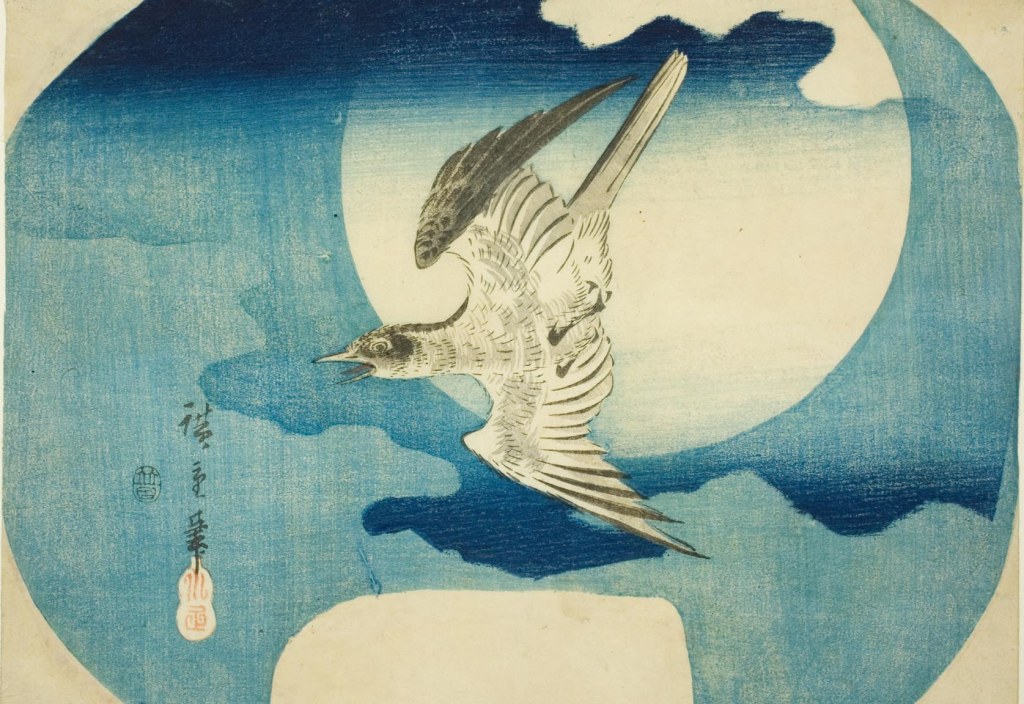
The following haiku is unclear to me. Is the cuckoo in a patch of irises five feet wide, or perched on a five foot tall iris? The later 18th century artist Utagawa Hiroshige (歌川 広重) drew a picture of a cuckoo flying above a tall iris suggesting the later.

hototogisu / naku ya go shaku no / ayamegusa
a cuckoo crying above a five-foot iris.
ほととぎす鳴くや五尺の菖草

hototogisu / ō takeyabu o / moru tsuki yo
a cuckoo in a bamboo grove on a moonlit night
ほととぎす大竹薮を漏る月夜

In 1689, on the journey north (Oku no Hosomichi), Basho visited the waterfall Urami-no-Taki, so named because one could walk behind the cascading falls. The rhyming words “urami” and “ura omote” coming to mind. The suggestion, I suppose, that one has a private face and a public face. Sometimes we have to hide to see reality.

For a while I hid under the waterfall at the start of the Summer Retreat.”

hototogisu / Urami-no-taki no / ura omote
a cuckoo as seen behind the waterfall, back and front
ほととぎす裏見の滝の裏表

For additional Basho haiku on the cuckoo and alternate translations and comprehensive explanations see:

matsuobashoblogspot

teressbess

Also see Hototogisu, the longest running Japanese haiku magazine.

Hiroshige, Cuckoo and Iris

How Interesting

Ten Years

Almost ten years had passed by.

Five years since Records of a Weather-Exposed Skeleton (1684), a journey west to Kyoto and Nara. One year since A Visit to Sarashina Village, a journey to Nagano and moon viewing at the rice fields, 1688.

Ten years since Matsuo Basho left Edo, crossing the Sumida River, taking up residence in a simple cottage, away from the crowds. If this hut was like Minomushian, the Iga retreat Basho occasionally used, it was a simple house with a couple of tatami mat and a sliding divider between the bedroom and living/dining area. A garden space surrounded the house and perhaps an indoor garden that could be viewed from inside. Outside, there was a banana tree, a gift of a disciple, and the origin of the name Basho (banana plant).

Almost ten years had past, and Basho was again feeling restless.

Like his idol, Saiygo, the 12th c. Japanese monk and poet, Basho wished to travel again. This time with his neighbor and friend, Kawai Sora (河合曾良), who would accompany him on his most famous journey, Oku no Hosomichi, in the spring of 1689.

おもしろや ことしの春も 旅のそら
omoshiro ya kotoshi no haru mo tabi no sora

how interesting!
this spring, I shall go
traveling on the Road (with Sora)

Matsuo Basho, Edo, 1689

After this, Matsuo Basho had one more trip. His last.

Japanese cottage

Omoshiro ya

Omoshiro ya, おもしろや, how interesting, or fun.

There is not much interesting about this haiku except for its connection with Sora, Basho’s traveling companion on the Oku no Hosomichi. The two took their famous journey to the northern interior of Japan in the spring of 1689. Tabi no Sora, 旅のそら (旅の空), literally, a Journey under the Sky, meaning on the open road.

Of course, the homophone “sora” may just be a coincidence. Life is full of them

More omoshiro:

How, pray tell, does rain become snow?

面白し雪にやならん冬の雨
omoshiroshi / yuki ni ya nara n / fuyu no ame
how interesting / snow is / winter’s rain (winter, 1687)

In summer the ancient art of catching sweet fish is done using lanterns to attract the fish and cormorant birds to dive in the water and swallow the fish. A noose around the bird’s neck prevents it from swallowing the fish.

おもしろうてやがて悲しき鵜舟哉
omoshirō te / yagate kanashiki / u-bune kana
how exciting / then sad / fishing with cormorant (summer, 1688)

Shortly before he died.

おもしろき秋の朝寝や亭主ぶり
omoshiroki / aki no asane ya / teishu buri
how pleasant / asleep on a summer’s afternoon / like the lord of the house (autumn, 1694)

On the Road Again

On the road again
Just can’t wait to get on the road again

On the Road Again, Willie Nelson

Traveling seems to be in our DNA. We take vacations, we change jobs, we move. And children move away from their parents. The human population covers the world. Traveling is in our genes.

Basho, like Jack Kerouac and other literary figures, was on the road a lot. Inbspired by the poet Saiygo, Basho made as many as five travels within Japan that became the subject of books or travelogues.

“Live, travel, adventure, bless, and don’t be sorry.”
生きて、旅して、冒険して、祝福して、後悔しないでください。

On the Road, Jack Kerouac, 1957

Crested Butte, Colorado

A mountain

Like a dinosaur tooth

Crested Butte

Crested Butte
Colorado, September 2022

Crested Butte, September 2022

Late in the day, much too late, the wife and I were hiking a short trail outside Crested Butte, past the ghost town of Gothic. The trail marker said half mile to Judd Falls. A Japanese couple returning from the hike to Judd Falls said hello. And in that strange language that people from different cultures try to talk, told us it was getting dark and too far. As we would learn, they were right, the sign was wrong. Judd Falls was much further and darkness fell as we walked.

The hike, the mountain, the golden Aspen, the falls, the friendly Japanese couple, all reminded me of Basho’s many walks.

A fox, no two

Waiting on a path

For who

Gothic, Colorado

Early next morning we rose as the earth awoke.

Clouds part

Like sheets on a bed

As the mountain rises

In an Aspen grove

Fluttering leaves do gossip

I wonder

Lightning

lightning in the dark sky

A flash of lightning in a September cloud, a Zen reflection on the impermanence of life, but to those don’t know, a precious thing to behold.

A flash of lightning
Yet unenlightened,
How noble!
稲妻にさとらぬ人の貴さよ
inazuma ni / satoranu hito no / tattosa yo

Matsuo Basho, 1690

Figuratively and Literally

Mid-September, 2022, crossing Kansas along US 160, coming home from Las Vegas, New Mexico. In the Gypsum Hills between Meade and Medicine Lodge, the route featured flat mesas, long canyons and arroyos, red rolling hills, and vast empty stretches with no living beings.

Gypsum Hills, Kansas

As day turned to evening, and evening to darkness, my wife and I were entertained by a show of lightning to the north.

Beautiful,” said my wife.

Inazuma (稲妻, a flash of lightning) ni (with); satora (さとら, enlightened, understanding, one realizes) nu (ぬ, not) hito (人, people, one person) no (の, possessive); tattosa (貴さ, noble and precious).

Yo (よ, yo, indicating certainty).

Spiritually

Matsuo Basho in 1690, at the age of 47 with but three years to live. He had completed his journey of northern Japan, Oku no Hosomichi — How noble and precious, he who doesn’t think, “life is fleeting,” when seeing a flash of lightning.

Our existence in this fleeting world:
A drop of dew in the morning, a bubble in a stream,
A flash of lightning in a summer cloud,
A flickering lamp, an illusion, a phantom, a dream…
Thus spoke Buddha.

Diamond Sutra, Chap. 32
稲妻, a flash of lightning

Farewell

At a renga party. One hundred verses, the last haiku. How do get rid of the last annoying guest? With sleepy eyes, your host appears, your hat and summer coat in hand.

time to say farewell —
your hat and summer coat
in hand
別れ端や笠手に提げて夏羽織
wakareba ya kasa te ni sagete natsu-haori

Matsuo Basho, Fukagawa, Summer 1684

Summer 1684

I have invented a renga party as the occasion for the farewell and this haiku.

By the summer of 1684, Matsuo Basho was living in Fukagawa in the Basho-an (his simple cottage shaded by a banana, a.k.a, basho, tree), adored by his students and disciples. Basho’s mother had died the year before. He was restless.

As summer became autumn, it was time to go home, to say goodbye.

Notes on Translation

Renga (連歌, linked haiku), usually of 36 or even 100 verses. Wow! That’s long.

Those crazy Japanese poets!

One person writes the first hokku (haiku), identifying a single subject (i.e cherry blossoms, the autumn moon, goodbyes and farewells), each person adding to the chain, but delivering a creative twist. Now, the party has gone on too long, too late. The guests have drunk too much and most have left. Saki cups and paper haiku litter the floor.

Wakareba (別れ端や) I get it, I understand, after some difficulty. Farewell!

Kasa (笠) hat. Haori (はおり), a thigh-length jacket with short sleeves, generally used for cold evenings. Basho describes it as a summer (natsu, 夏) garment, suggesting that the season is changing.

Fukagawa. By the age of 36, Matsuo Basho had achieved some success in Edo, the capital of Japan. He had refined the haiku as an art form, and the renga as a convivial setting for its connected verse. He had a group of devoted students and disciples who referred to him as Tosei, the unripe peach. Matsuo wanted more, and departed Edo in 1680 for the more rural Fukagawa district, where, beside his small cottage, he planted a banana tree (basho), saying farewell to Tosei, eventually becoming Basho.

summer, natsu, 夏

Ogaki

Ogaki, Japan, 1689

The final stop of Oku no Hosomichi, the Journey to the Northern Interior. Ogaki is in Gifu Prefecture (then Mino Province), west of Nagoya. If there is a historical reason for chosing this spot, it is this. On the 15th day of the 9th month, the Battle of Sekigahara (関ヶ原の戦い) took place in western Mino Province. The victory of Tokugawa Ieyasu eventually led to the Tokugawa Shogunate and the beginning of the Edo Period.

Basho’s only hint as to why the journey ended here is in closing haiku — yuki aki zo, autumn is passing by. If one plays word games then consider this. Yuki may mean happiness, 幸 (yuki) or snow, 雪. Combined, 由 (yu) meaning “reason” with 貴 (ki), it can mean it a “good reason” to stop.

Oku no Hosomichi

From Basho’s notes: Ogaki

The 21st day of the 8th lunar month, arrived Ogaki. My followers gather to work.

On the 6th day of the 9th lunar month, Basho sets off by boat, “I am going to Ise to visit the Grand Shrine.”

When clams split in two, autumn is passing
hamaguri no / futami ni wakare / yuku aki zo

Oku no Hosomichi, last entry, Matsuo Basho, 1689

Note on Translation. Monjin, (), borrowed from the Chinese, meaning a disciple, follower, pupil, or student. Figuratively, one who waits at the gate.

Japanese

大垣

8月21日頃、大垣に到着。
門人たちが集い労わる。

9月6日 芭蕉は「伊勢の遷宮をおがまんと、また船に乗り」出発する。


蛤(はまぐり)の ふたみにわかれ行く 秋ぞ

Note on dates. The Japanese lunar month was about a month earlier than our modern calendar.

Hamaguri, 蛤(はまぐり), Clams

Said the Spider

Spider, spider, speak again!
what’s that you cry
— the autumn wind.
蜘蛛何と音をなにと鳴く秋の風
くもなにとねをなにとなくあきのかぜ
kumo nani to / ne o nani to naku / aki no kaze

Matsuo Basho, Edo, Autumn 1680
spider web

After a night of rain in the ninth month, the morning sun shines fresh. …On bamboo fences and criss-crossed hedges I saw spider webs all in tatters; and on the broken threads raindrops hung like strings of white pearls.

The Pillow Book, Sei Shionagon, 10th c.

The Mystery

Most spiders make no sounds at all, but a few can produce noises. I am no expert on Japanese spiders. The common Jumping spider is cute, but it makes no sound. The giant Joro spider is as big as your palm, again no sound unless it is “squish” when you step on it.

Basho’s haiku was inspired by the female poet Sei Shonagon and her delightful diary of court life, The Pillow Book (Makura no Soshi). Basho substitutes spiders for bagworms. Sei generally speaks of insects as creepy crawly things to be feared, but here she sees the beauty in the web they’ve spun. Another poem speaks of minomushi, the bagworm that makes a sound chichi-yo, chichi-yo, which sounds like “father, father.”

[Note. Chichi-ue (父上 — ちちうえ), an archaic word for ‘honored father’ in Japanese. Compare:
父母のしきりに恋し雉の声
chichi haha no shikiri ni koishi kiji no koe
I long for my dead parents]

The Bagworm

Next year, Basho would muse about the bagworm, composing a haiku for his housewarming on the occasion of moving to Fukagawa into his new “humble” home, Basho-an. This would also be the occasion of Matsuo becoming Basho. Like the bagworm, and its insignificant sound, coming into the world.

Come listen to the sound
a bagworm coming into the world
— in my grass hut

蓑虫の音を聞きに来よ草の庵
minomushi no ne o kiki ni koyo kusa no io

Matsuo Basho, Fukagawa, Basho-an, 1681?

Nani to naku, in the first haiku, sounding like the word nothing — なに と なく.

Plum Blossom

Summer 2022

A morning walk beside the creek
A heavenly breeze, the rising sun
Here comes the heat!

Bashō no yōna, August 2022

On the Today show, Al Roker points to a map covered in RED on the weather map. Record Heat. The days and weeks are full of sun, it’s been months since it was cool. An early morning walk with the dogs inspires Bashō no yōna’s poor attempt at haiku.

Winter 1693-94

Now, two haiku by Matsuo Basho written in early 1694. The subject, the early blooming Plum Blossom. A literary respite from the summer heat.

Fragrant plum fills the air
And the rising sun on
A mountain path! 

梅が香にのつと日の出る山路かな
ume ga ka ni notto hi no deru yamaji kana

Plum Blossom Scent, (Ume ga Ka, 梅が香), Spring 1694

Was the snow still falling? Was it bitterly cold? Did the birds sing when the sun rose?

Note. In the early spring of Matsuo Basho’s last year, he and Shida Yaba 志太野坡 composed a haiku sequence (renga) that came to be called Ume ga Ka (Plum Blossom Scent). Ume, (plum), the five petals symbolize the Five Blessings: old age, wealth, health, virtue, and a peaceful death.

梅が香に昔の一字あはれなり
ume ga ka ni mukashi no ichiji aware nari

The fragrant plum,
The days of old,
That nothing last — ’tis a pity.

Matsuo Basho, February 1694

Note. This second haiku addressed to his student Baigan 梅丸 who had recently lost his son. Ume ga ka, the fragrant plum. Ni, a participle indicating movement or direction. Mukashi, the days of old, the past. No, acts as an indicator of possession. Ichiji. a reference to life’s impermanence. Aware, a pity, something that’s sad. Nari indicates that the emotion follows quickly.

A plum blossom fades all too soon, and so does life. Matsuo Basho died later that year.

Ume no hana, the plum blossom

Ladybug

Ladybug, Ladybug
A bug with a house and wings to boot
— so cute

Bashō no yōna, August 2022

Note. In Japanese, ladybug is tentou-mushi, テントウムシ. That seems a mouthful, but not when you learn it literally means “a bug with a house.”

Bullet Train

Last night my wife and I watched Bullet Train starring Brad Pitt and Hiroyuki Sanada among others. Brad Pitt stars as Ladybug, an unlucky snatch and grab artist, and Hiroyuki Sanada as the Elder, an aging Japanese martial artist/mobster who is trying to protect his grandson and simultaneously seek revenge against the nefarious White Death, who has brought together a cast of bad characters on a Japanese Bullet Train.

In the penultimate scene, Elder (Sanada) explains “Ladybug” to Pitt, saying the bug is not unlucky. It captures all the bad luck in the world under its shell to protect the rest of the world.

Fate.

Ladybug, Ladybug
Bring me some luck
Fly, faraway home

Bashō no yōna, August 2022

Basho on Bugs

Matsuo Basho has no ladybug haiku. Ain’t that’s a shame.

But he did write about cicadas, butterfly, dragonflies, silkworms, lightening bugs, grasshoppers and crickets.

Oh my!

Trivia. In Bullet Train the train is going from Tokyo to Kyoto. The route is known as the Tōkaidō Road, formerly a walking path Basho took many times. The Bullet Train takes about 140 minutes to go from place to place. The move ran 126 minutes.