It rained last night in Dallas. A hard rain with thunder and lightning, the kind of rain that makes my two dogs crawl underneath the covers, curl up, and hide. Today is no different. One might say it is raining cats and dogs or buckets, but that makes no sense to the dogs who are sadly staring out the window wondering.
It’s Thanksgiving, happy Thanksgiving, a good day to stay at home and cook, then to gather with friends and family, say a prayer and eat.
A rainy day in November
Dogs at the window
A hang-dog look
Our thoughts turn to what to do when it is raining so hard all one can say is, “Oh my God!”
It rained all night, it rained all day. It rained, then stopped, and rained again. It rained like someone pounding at my door. The windows rattled, as did I. It rained so much, I screamed, Enough!
Is it Her fault that She chose Thanksgiving as the day for us to stay home and ponder life’s mysteries.
I am not abandoning Matsuo Basho, but looking over his shoulder as he reads from a book of poetry by the 12th century Saigyo Hoshi (西行法師). Saigyo was both poet and wandering Buddhist monk whose travels inspired Basho’s own journeys.
Deep in the mountains, Water from rocks, drip drop, Me, gathering chestnuts Falling plop-plop
Saiygo, [Sankashū, Collection from a Mountain Home, 1290]
And what, dear reader, do you suppose Basho thought when he read the words “katsu-katsu?” — “kerplunk,” a pond and a frog, that’s the sound of water.
Late November
It is late November in the Midwest where, much to the delight of squirrels, spiny chestnuts, prickly tot the touch, are falling all about in my backyard, such that two dogs are loathe to play. Later, out for a peaceful walk, I am in the woods where the plop-plop of falling walnuts surprise my dogs.
Katsu-katsu (かつかつ) a word shouted out in Zen Buddhism to induce a state of Enlightenment. Also, an onomatopoeic phrase to indicate clicking, clopping; clacking, plop-plop. Tochi (橡), chestnuts.
The candy’s gone. A little sadness, some melancholy, descends on one the day after Halloween night. A beautiful moonlit evening, houses decorated gaily, neighbors wondering if they have enough candy, kids in costumes, smiling, politely asking for candy.
“Trick or treat.”
But night turns into day
The parents safely tucked the younger children in bed by eight. The older children walked the streets til late. Now, they are back in school, or they slept in, suffering from a tummy ache.
The falling leaves, a moonlit night, costumed kids, all so polite, “trick or treat” its so much fun, until the candy’s gone — Halloween
Bashō no yōna, 2022
Saigyo
The 12th century poet Saigyō Hōshi (西行法師) wrote this short poem after a fruitless day of cherry blossom viewing and hazy night and moon watching. In the best Buddhist tradition, turning a negative thought into one that is positive. Teaching us that on the morning after Halloween, sadness can be sweet.
花散らで月は曇らぬ世なりせば物を思はぬわが身ならまし hana chirade / tsuki wa kumoran / yo nariseba / mono o omowan / waga mi naramashi
西行, Saigyo
Were it not for falling blossoms and a cloudy moon, in such a world I could not feel this sadness
Eine Welt ohne Zerstreuen von Blüten und ohne Bewölken des Mondes, würde mich meiner Melancholie berauben
le monde sans fleurs qui tombent et une lune assombrie vole moi ma mélancolie
“Where does Du Fu live?” travelers often asked of the reclusive Chinese poet.
And locals replied, “Down by the riverbank, underneath old Nanmu.”
The 17th century Japanese haiku poet Matuso Basho had his Basho, the weakly banana tree; the 8th century Chinese poet Du Fu, Nanmu, a tall stately conifer.
The Storm
In 759, in the midst of the devastating An Lushan Rebellion, the Chinese poet Du Fu moved to Chengdu. He stayed there in relative safety for four years, quietly writing poetry waiting for the storm to pass. For Du Fu, the Nanmu tree in front of his thatched cottage was a refuge in the broader political struggle between the Tang dynasty and rebelling troops who were primarily foreigners. The Dragon mentioned in the poem was the imperial symbol of the Tang Dynasty. The tiger, the rebels.
Following this is Matsuo Basho’s haiku about rain dripping in pots during a thunderstorm.
My Nanmu Uprooted by the Storm and Sighing
My Nanmu leaned on the river bank, in front of my thatched cottage, An age old legend says that it’s two hundred years old. It was foretold its thatch should cover my home, In May one could already hear the cicadas warning.
When a southeast wind came and violently shook the land, The river churned, stones tossed, among gusts of flowing clouds. But my tree held back the thunderstorm in a battle of strength, Is it heaven’s mandate to choose to cut the roots?
In a dismal storm an old tree is the best place to be, Underneath thick foliage of an evergreen tree. Passing travelers lingered here, afraid of snow and frost, And those who walked came to listen to the music in its branches.
As the tiger falls to the dragon, cast into a thorny patch, Tracks of tears and drops of blood fall onto my chest. Where shall I go to sing my poems? From this point on, my thatched cottage lacks all color.
Du Fu, ca. 759-763
Notes. The pine tree is a symbol of perseverance in winter and longevity. But what happens when a storm fells a tree? The cicada was a symbol of Du Fu’s simple, humble lifestyle. Tianyi, heaven’s mandate, fate. The wind blowing through the pine needles was a familiar Chinese metaphor for nature making its own music. For the meteorologically inclined: a southeast wind could mean both a wind that is out of the southeast and one that is southeast in direction. The An Lushan Rebellion began in the northwest and came south. “Feng” winds (Du Fu uses the term piaofeng, a whirlwind) were associated with violent, erratic, and disruptive storms.
Other Sources. A comprehensive collection of Du Fu’s poetry is found online in PDF format.. Search Du Fu and Steve Owens. Owens’ work complements another work by Xiaofei Tian, Du Fu quanji jiaozhu 杜甫全集校注, which is also available online in PDF format.
柟樹為風雨所拔歎 倚江柟樹草堂前, 古老相傳二百年。 誅茅卜居總為此, 五月髣髴聞寒蟬。
東南飄風動地至, 江翻石走流雲氣。 幹排雷雨猶力爭, 根斷泉源豈天意。
蒼波老樹性所愛, 浦上童童一青蓋。 野客頻留懼雪霜, 行人不過聽竽籟。
虎倒龍顛委榛棘, 淚痕血點垂胸臆。 我有新詩何處吟, 草堂自此無顏色。
Here is Matsuo Basho’s haiku about the banana tree outside his cottage in an autumn storm.
Banana tree in a fierce autumn gale I wonder if I can hear Rain in the tub, tonight!
I get together with three old friends and play bridge once a month. No one is especially good, some are worse than others, and the bidding systems never seem to get straightened out. If bids are like smoke signals, they tend to get obscured by the constant table talk. Often after a bid, a puzzled look comes over my partner’s face followed by a single word,
“Well.”
To which there are various haiku like responses like this one:
Well, a deep subject, full of water or empty.
To which, in renga like fashion, another player may add:
Whale, big and white — Moby Dick
And my dear deceased father-in-law would say:
Well, it’s as cold as a well digger’s ass, in Winter.
Haiku lives
Three lines, two things combine, to make One. Haiku is the divine Act of Creation.
Later, in one of those random acts of spontaneous discovery, I was looking into the ever expanding internet well, and its random contributions, when I came across the name Gao Xingjian. He is the first Chinese writer to win the Nobel Prize for literature.
Curious, I went back to the well and began reading from his writings. Here is a partial quote from a short poem of six lines. I have included the first three as it seems appropriate her.
Well,
Endlessly deep
God …
Gao Xingjian, Wandering Spirit and Metaphysical Thoughts
Well, reading on, Nobel being on my mind, I discovered that this year’s Nobel Prize for literature went to Annie Ernaux. The explanation, (for one must always explain one’s self), “for the courage and clinical acuity with which she uncovers the roots, estrangements and collective restraints of personal memory”
Haiku lives.
Well, my daughter and I were talking the other day about Virginia Woolf. She, who suffered from depression most of her life, and took her life by suicide one spring day in March. Filling her coat pockets with stones and wading into the River Ouse in Sussex. Well, the river is not fast, it is not wide, the process of taking one’s life could not have been easy.
Well, that leads to this thought:
Well, a deep depression, sometimes dug by hand.
One can read Virginia Woolf and one should. Along with James Joyce, she developed the “stream of consciousness” point of view. Gertrude Stein called it “continuing present.” Her writing style influenced other writers such as William Faulkner, F. Scott Fitzgerald, Ernest Hemingway. She is perhaps, the very first modern “feminist” writer, though my daughter and I disagree on what that term means. (Sappho was the first recorded feminist, that is if one neglects Eve who convinced Adam it was time to leave Paradise and work for a living.)
I have modified a few of her quotes as follows:
Well, I find it more difficult to murder a phantom, than reality.
Well, a woman has no country, the world is my country.
On the outskirts of agony, some fellow sits, watching, pointing.
History does not record, but anonymous, was most often a woman.
Well, nothing really happens, unless it is written and recorded.
As for her final thought, who knows? Possibly this:
Someone has to die, that the rest of others should value it more.
Last thought:
Wasn’t it Virginia Slims cigarettes that came up with the slogan, “You’ve come a long way baby.”
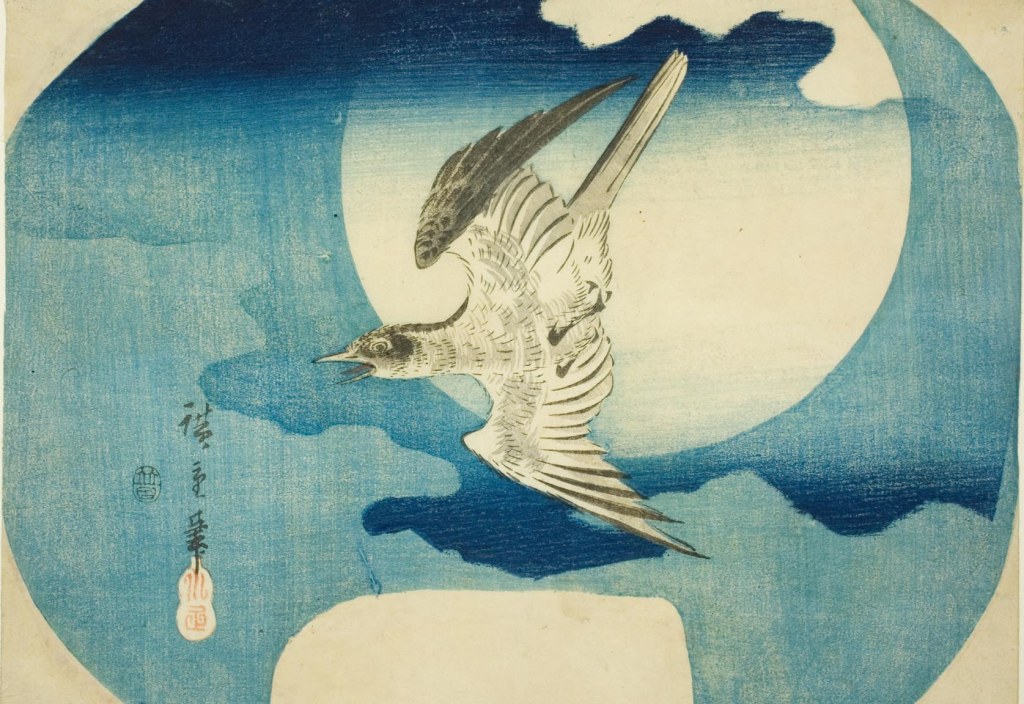
The cuckoo is considered a lazy bird, a clever bird, whose rhyming call gives it its western name — kyo, kyo. Cuckoos are brood parasites, meaning their young are raised by other birds.
Therefore, much like a poet.
There is also the familiar story of the warlords Oda Nobunaga, Toyotomi Hideyoshi, and Tokugawa Ieyasu who said:
Oda Nobunaga: 鳴かぬなら殺してしまえ時鳥 nakanu nara koroshite shimae hototogisu, if the cuckoo does not sing, kill it.
Toyotomi Hideyoshi: 鳴かぬなら鳴かしてみしょう時鳥 nakanu nara nakashite mishō hototogisu, if the cuckoo does not sing, coax it
Tokugawa Ieyasu: Nakanu nara naku made matte miyou hototogisu 鳴かぬなら鳴くまで待ってみようホトトギス if the cuckoo doesn’t sing, wait until it does.
Cuckoos
Soon after completing his epic journey to the northern interior (Oku no Hosomichi), Basho remembered his student days in Kyoto and wrote:
Even in Kyoto, one yearns for the cry “kyoo-kyoo” and the cuckoo Kyoo nite mo, Kyoo natsukashi ya, hototogisu 京にても 京なつかしや 時鳥
Matsuo Basho, 1690
Here is a sampling Matsuo Basho’s haiku beginning with 時鳥 and ほととぎす and its variations — hototogisu (cuckoo).
hototogisu / ima wa haikaishi / naki yo kana the cuckoo sings and the world has no poets 時鳥鰹を染めにけりけらし
It is a common belief that the cuckoo vomits blood. Bonito or Skipjack Tuna are a popular fish in Japan with a deep red color.
hototogisu / katsuo o some ni / keri kerashi the cuckoo stains the Bonito fish I suppose 時鳥鰹を染めにけりけらし
hototogisu / kie yuku kata ya / shima hitotsu a cuckoo flying to an island becoming one thing ほととぎす消え行く方や島一つ
hototogisu / koe yokotau ya / mizu no ue the cuckoo flies, singing, stretching out, on the cold water lies 郭公声横たふや水の上
hototogisu / maneku ka mugi no / mura obana a cuckoo invited by barley and its waving fronds 郭公招くか麦のむら尾花
hototogisu / matsuki wa ume no / hana sake ri the cuckoo and plum flowers in June, both have bloomed 時鳥正月は梅の花咲けり
hototogisu / naku naku tobu zo / isogawashi The cuckoo, crying, singing, flying, oh, so busy ほととぎす鳴く鳴く飛ぶぞ忙はし
The following haiku makes sense if one imagines that Basho’s writing box (suzuri-bako, 硯箱) has the image of a singing cuckoo on the lid.
hototogisu / naku ne ya furuki / suzuri-bako the cuckoo singing in a tree and on my writing box 杜鵑鳴く音や古き硯箱
The following haiku is unclear to me. Is the cuckoo in a patch of irises five feet wide, or perched on a five foot tall iris? The later 18th century artist Utagawa Hiroshige (歌川 広重) drew a picture of a cuckoo flying above a tall iris suggesting the later.
hototogisu / naku ya go shaku no / ayamegusa a cuckoo crying above a five-foot iris. ほととぎす鳴くや五尺の菖草
hototogisu / ō takeyabu o / moru tsuki yo a cuckoo in a bamboo grove on a moonlit night ほととぎす大竹薮を漏る月夜
In 1689, on the journey north (Oku no Hosomichi), Basho visited the waterfall Urami-no-Taki, so named because one could walk behind the cascading falls. The rhyming words “urami” and “ura omote” coming to mind. The suggestion, I suppose, that one has a private face and a public face. Sometimes we have to hide to see reality.
“For a while I hid under the waterfall at the start of the Summer Retreat.”
hototogisu / Urami-no-taki no / ura omote a cuckoo as seen behind the waterfall, back and front ほととぎす裏見の滝の裏表
For additional Basho haiku on the cuckoo and alternate translations and comprehensive explanations see:
Five years since Records of a Weather-Exposed Skeleton (1684), a journey west to Kyoto and Nara. One year since A Visit to Sarashina Village, a journey to Nagano and moon viewing at the rice fields, 1688.
Ten years since Matsuo Basho left Edo, crossing the Sumida River, taking up residence in a simple cottage, away from the crowds. If this hut was like Minomushian, the Iga retreat Basho occasionally used, it was a simple house with a couple of tatami mat and a sliding divider between the bedroom and living/dining area. A garden space surrounded the house and perhaps an indoor garden that could be viewed from inside. Outside, there was a banana tree, a gift of a disciple, and the origin of the name Basho (banana plant).
Almost ten years had past, and Basho was again feeling restless.
Like his idol, Saiygo, the 12th c. Japanese monk and poet, Basho wished to travel again. This time with his neighbor and friend, Kawai Sora (河合曾良), who would accompany him on his most famous journey, Oku no Hosomichi, in the spring of 1689.
おもしろや ことしの春も 旅のそら omoshiro ya kotoshi no haru mo tabi no sora
how interesting! this spring, I shall go traveling on the Road (with Sora)
Matsuo Basho, Edo, 1689
After this, Matsuo Basho had one more trip. His last.
Japanese cottage
Omoshiro ya
Omoshiro ya, おもしろや, how interesting, or fun.
There is not much interesting about this haiku except for its connection with Sora, Basho’s traveling companion on the Oku no Hosomichi. The two took their famous journey to the northern interior of Japan in the spring of 1689. Tabi no Sora, 旅のそら (旅の空), literally, a Journey under the Sky, meaning on the open road.
Of course, the homophone “sora” may just be a coincidence. Life is full of them
More omoshiro:
How, pray tell, does rain become snow?
面白し雪にやならん冬の雨 omoshiroshi / yuki ni ya nara n / fuyu no ame how interesting / snow is / winter’s rain (winter, 1687)
In summer the ancient art of catching sweet fish is done using lanterns to attract the fish and cormorant birds to dive in the water and swallow the fish. A noose around the bird’s neck prevents it from swallowing the fish.
おもしろうてやがて悲しき鵜舟哉 omoshirō te / yagate kanashiki / u-bune kana how exciting / then sad / fishing with cormorant (summer, 1688)
Shortly before he died.
おもしろき秋の朝寝や亭主ぶり omoshiroki / aki no asane ya / teishu buri how pleasant / asleep on a summer’s afternoon / like the lord of the house (autumn, 1694)
On the Road Again
On the road again Just can’t wait to get on the road again
On the Road Again, Willie Nelson
Traveling seems to be in our DNA. We take vacations, we change jobs, we move. And children move away from their parents. The human population covers the world. Traveling is in our genes.
Basho, like Jack Kerouac and other literary figures, was on the road a lot. Inbspired by the poet Saiygo, Basho made as many as five travels within Japan that became the subject of books or travelogues.
“Live, travel, adventure, bless, and don’t be sorry.” 生きて、旅して、冒険して、祝福して、後悔しないでください。
Late in the day, much too late, the wife and I were hiking a short trail outside Crested Butte, past the ghost town of Gothic. The trail marker said half mile to Judd Falls. A Japanese couple returning from the hike to Judd Falls said hello. And in that strange language that people from different cultures try to talk, told us it was getting dark and too far. As we would learn, they were right, the sign was wrong. Judd Falls was much further and darkness fell as we walked.
The hike, the mountain, the golden Aspen, the falls, the friendly Japanese couple, all reminded me of Basho’s many walks.
A flash of lightning in a September cloud, a Zen reflection on the impermanence of life, but to those don’t know, a precious thing to behold.
A flash of lightning Yet unenlightened, How noble! 稲妻にさとらぬ人の貴さよ inazuma ni / satoranu hito no / tattosa yo
Matsuo Basho, 1690
Figuratively and Literally
Mid-September, 2022, crossing Kansas along US 160, coming home from Las Vegas, New Mexico. In the Gypsum Hills between Meade and Medicine Lodge, the route featured flat mesas, long canyons and arroyos, red rolling hills, and vast empty stretches with no living beings.
Gypsum Hills, Kansas
As day turned to evening, and evening to darkness, my wife and I were entertained by a show of lightning to the north.
“Beautiful,” said my wife.
Inazuma (稲妻, a flash of lightning) ni (with); satora (さとら, enlightened, understanding, one realizes) nu (ぬ, not) hito (人, people, one person) no (の, possessive); tattosa (貴さ, noble and precious).
Yo (よ, yo, indicating certainty).
Spiritually
Matsuo Basho in 1690, at the age of 47 with but three years to live. He had completed his journey of northern Japan, Oku no Hosomichi — How noble and precious, he who doesn’t think, “life is fleeting,” when seeing a flash of lightning.
Our existence in this fleeting world: A drop of dew in the morning, a bubble in a stream, A flash of lightning in a summer cloud, A flickering lamp, an illusion, a phantom, a dream… Thus spoke Buddha.
At a renga party. One hundred verses, the last haiku. How do get rid of the last annoying guest? With sleepy eyes, your host appears, your hat and summer coat in hand.
time to say farewell — your hat and summer coat in hand 別れ端や笠手に提げて夏羽織 wakareba ya kasa te ni sagete natsu-haori
Matsuo Basho, Fukagawa, Summer 1684
Summer 1684
I have invented a renga party as the occasion for the farewell and this haiku.
By the summer of 1684, Matsuo Basho was living in Fukagawa in the Basho-an (his simple cottage shaded by a banana, a.k.a, basho, tree), adored by his students and disciples. Basho’s mother had died the year before. He was restless.
As summer became autumn, it was time to go home, to say goodbye.
Notes on Translation
Renga (連歌, linked haiku), usually of 36 or even 100 verses. Wow! That’s long.
Those crazy Japanese poets!
One person writes the first hokku (haiku), identifying a single subject (i.e cherry blossoms, the autumn moon, goodbyes and farewells), each person adding to the chain, but delivering a creative twist. Now, the party has gone on too long, too late. The guests have drunk too much and most have left. Saki cups and paper haiku litter the floor.
Wakareba (別れ端や) I get it, I understand, after some difficulty. Farewell!
Kasa (笠) hat. Haori (はおり), a thigh-length jacket with short sleeves, generally used for cold evenings. Basho describes it as a summer (natsu, 夏) garment, suggesting that the season is changing.
Fukagawa. By the age of 36, Matsuo Basho had achieved some success in Edo, the capital of Japan. He had refined the haiku as an art form, and the renga as a convivial setting for its connected verse. He had a group of devoted students and disciples who referred to him as Tosei, the unripe peach. Matsuo wanted more, and departed Edo in 1680 for the more rural Fukagawa district, where, beside his small cottage, he planted a banana tree (basho), saying farewell to Tosei, eventually becoming Basho.




 matsuo-basho-haiku