Leaving Lake Kahola, Chase County Kansas, driving along an old country road, the dogs, too exhausted from their run, lie down in the back of the car, and sleep, hardly a peep can be heard, dreaming of rabbits. I wonder, do they catch their prey, and if they do, then what?
In Kansas, I-70 runs east just over 424 miles (682 km) from Colorado border near Kanorado through Colby and Russell, to Salina, past Manhattan, Topeka, and Lawrence, to the Missouri border in Kansas City. Most Kansans head west to Colorado. Most Easterners heading west say, “I thought it would never end.”
How flat is it, hmmm?
So flat, Kansas
Is flatter than a pancake
The summer wind can be brisk, making driving difficult.
A South Wind
Is a Cross-wind
On Kansas I-70
Mostly amber waves of grain and grassland and grazing cattle. Not much to look at along the way.
Since Matsuo Basho kept time by the Japanese lunar calendar, one can not know the exact dates, but that does not matter, it was hot, Matsushima was behind them. Matsuo Basho and Sora were headed inland.
It appears from a map of Basho’s stops along the Oku no Hosomichi that Hiraizumi was enough. Here Basho marveled on the glory of three generations of the Fujiwara clan that passed as if in a dream. And as Nanbu was still far to the north, the two decided to turn back and stay the night in Iwate, heading towards the Hot Springs of Narugo and some welcome relief.
Difficulties lie ahead.
Note. Written on the 17th day of the 5th lunar month.
尿前の関 Shitomae no Seki Shitomae Barrier
By now, Basho and Sora had traveled some 300 miles from Edo. Perhaps, they looked a little worse for the wear and tear, tired and bedraggled. At the Shitomae Barrier, the they were eyed suspiciously by the border guards at the security station. Perhaps, it was time to start thinking of going back, but not quite yet.
“The road to Nanbu [a distant town in today’s Aomori Prefecture, also spelled Nambu] is far, so we stayed the night in Iwate [both the name of a province and a town]. The next day, we passed by Ogurazaki and Mizu-no-ojima [on Japan’s National Route 47, a statue of Basho is on the highway, looking south], then to the hot springs at Narugo, headed for the Barrier at Shitomae, intending to cross into Dewa Province.
The road was hardly used and the guards at the checkpoint examined us suspiciously. We just managed to get through. Marching up the mountain, darkness began to fall, so when we saw a house belonging to the border guard. We asked for shelter. For three whole days, a wild storm raged, trapping us there among the dark and dreary mountains:”
蚤虱 . 馬の尿 . する枕もと nomi shirami uma no bari suru makuramoto
fleas and lice, (what’s more), a horse is pissing, beside my pillow — Matsuo Basho, Oku no Hosomichi, Summer, 1689
Let us settle the debate once and for all. Basho is said to have composed a famous haiku that goes:
松島や . ああ松島や . 松島や Matsushima ya . Ā Matsushima ya . Matsushima ya Ah, Matsushima, Oh, Matsushima, Matsushima, ah!
In an article written after the severe earthquake in 2016, Takayangi Katsuhiro writes, “… the popular comic poet Tawara-bo composed a similar poem (Matsushima ya sate Matsushimaya Matsushima ya), and this has been conveyed erroneously as a work by Basho.”
There is no mention of Matsushima in Oku-no-Hosomichi. This is unusual in as much as Basho comments in the Prologue that he had been “dreaming of the full moon rising over the islands of Matsushima.”
“Why, then, did he not mention it in any of his haiku poems?” Katsuhiro asks. The answer is perhaps that of the Tao de Ching. Beauty is the word, but the word does not convey the feeling of each individual who takes in the beauty. Beauty is ineffable. Thus, one who speaks does not know, one who knows the beauty of Matsushima doesn’t speak.
It was by modern count, the 21st station on the journey. It followed Shiogama, on the coast just past Sendai. Today, boasting all manner of seafood. Basho’s description of Matsushima takes on the air of a travelogue, which the book Oku no Hosomichi was intended, in part, to be.
“Islands upon island, islands are joined to islands, looking exactly like parents walking hand in hand with them. Pine trees are of the brightest green, their exquisite branches, bent by the constantly blowing wind. Indeed, the beauty of the scene can only be compared to the most divinely endowed feminine face, for who else could have created such beauty but Nature herself? My pen could hardly rise to the task of describing this divine creation.”
With no words of farewell, no regret, Basho says, “I left for Hiraizumi (back into the interior) on the twelfth (of June).” And, as sometimes happens, he lost his way.
A question for Zhungzi — are dreams better than reality?
Is the dream better than reality, or do we care about the truth?
All of this reminding me of the Demosthenes’ saying, “One believes not in the truth, but in what one wants to believe.”
Source: Takayanagi Katsuhiro, “A Journey Along the Destroyed Oku no Hosomichi (Narrow Road to the Deep North),” 2016.
“The girls loved him.” — I had a friend in college, He was a poet, I was not.
Bashō no yōna, Haiku variations, 2024
Don’t be a split melon, Basho said, don’t copy him. So, from time to time, I will post haiku variations. Yes, I did have such a friend, and I envied him.
[Note. 風羅, literally, the wind that shifts; 坊, monk. Basho idolized Saigyo, a 12th century monk who wandered.]
The thought first appeared to Matsuo Basho in Oi no Kibumi (1688). That he, Matsuo Basho, like Saigyo, had become a wanderer with no fixed home. Furabo appears in the introduction, in the first line.
百骸九竅の中に物有、かりに名付て風羅坊といふ。 “Somewhere within my body of 100 bones and 9 orifices is something I call Furabo (風羅坊).”
The thought became an idea that reappeared not too far into Basho’s Journey into the Northern Interior (Oku no Hosomichi, 1689). Basho and his companion Sora spent a couple of days in Nasu, at the home of Takaku Kakuzaemon, the village headman. The village had hot springs which must have come as a relief to the two travelers. Nearby were several volcanic mountains, and a place called seessho-kiki, the killing rocks, so named because the sulfuric fumes were poisonous. Perhaps, Basho heard the familiar sound of the cuckoo bird, “kakkou kakkou” and compared that to the name of his host, Takuku. Taking this call as a warning to “rest.”
Basho wrote, 落ち来るや高久の宿の郭公.
ochikuru ya | falling down from high takaku no shuku no | at Takaku’s inn hototogisu | a cuckoo bird
Matsuo Basho, Oku no Hosomichi, Nasu, Summer 1689
and signed his name as Furabo.
If Basho was thinking of changing his pen-name to Furabo, it was too late.
I have two rescue dogs (a bonded pair I call Lucy and Desi) who love to go out the kitchen door and come back in all day. Occasionally, I leave it ajar so they can go out and in on their own. If it is not wide enough, they will sit and stare, for they haven’t learned how to push. Then, to their amazement, there is a “creeack” as the wind opens it wide.
An open door policy is an invitation to flies, as my wife says.
“Cree-ack” was the sound of the wind as it opened the kitchen door
“Whizz” go the flies who furiously flee the swat of the swatter — Bashō no yōna, Spring 2024
Nature’s Sound
“Cree-ack” is a high pitched sound like chalk on a chalkboard. It startles.
Matsuo Basho was captivated by the sounds of Nature. There is the familiar sound of the wind in the trees, the joyful sound of the birds in spring, and the cuckoo that always reminded him of Kyoto (a Proustian moment). Then too there was the famous sound of the water as the frog jumped in the pond — “kerplunk.”
Surely, Matsuo was thinking of himself when he wrote this haiku.
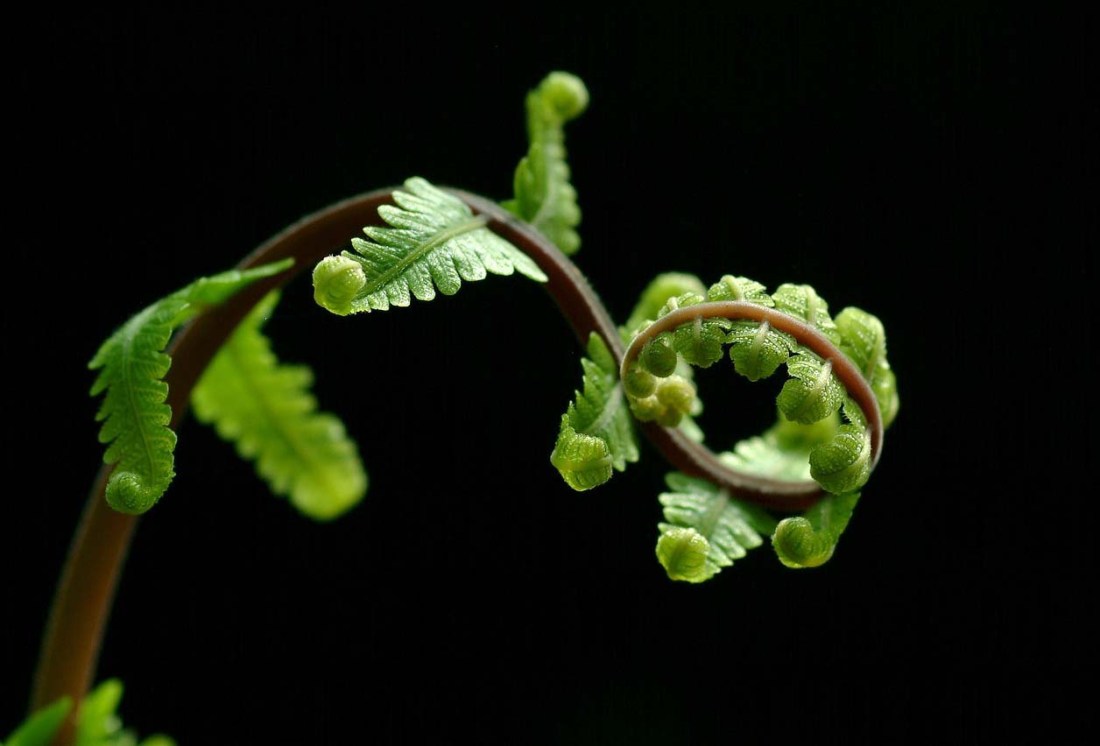
In May it rains and Ferns unfurls in light green color, But when?
五月の雨岩檜葉の緑いつまでぞ satsuki no ame iwahiba no midori itsumade zo
Matsuo Basho, Spring, Summer 1680
The fern becomes a metaphor for Matsuo. In May of 1680, he was not yet “Basho.” Rather, he was, to his friends and students, “Tosei,” the unripe peach. But he was about to change his color, to blossom, to ripen, to become a mature poet. First, to move to Fukagawa, then to travel, and along with the banana plant (basho) beside his simple cottage, become the beloved Basho, by which the world knows him.
But When
“But when?” or “How long?” This question Matsuo asks is personal. How long before Tosei ripens into a mature poet? How long does Matsuo stay in Edo, when other poets have struck out to explore Japan?
Notes on Translation
satsuki (May, or early Summer) no ame iwahiba (moss) nomidori (of green, “midori” is the light green color of early summer, spring) itsumade (until when) zo (emphasis)
Satsuki, fifth month which in the Japanese lunar calendar makes it June or early summer
Iwahiba, a type of fern resembling cypress in appearance that turns brown in winter and with the early rain unfurls into a light green color deepening to dark green as summer comes. It grows in heavily forested mountains and secluded valleys. In drought it closes into a ball.
Itsumade, an interrogative statement meaning “until when.” There is also an old Japanese story of a scavenging bird called “Itsumade” that descends on the dead and cries “itsumade, itsumade” meaning how long until the dead and rotting corpse becomes something else.
On the journey north, Oku no Hosomichi Obanazawa, ancient Dewa Province, The last week of May, Genroku 2, 1689
這ひ出でよ . 飼屋が下の . 蟇の声 hai ideyo . kaiya ga shita no . hiki no koe come out, come out! beneath the shed you croaking toad
Finding One’s Voice
It is one month into the journey that would become immortalized in Oku no Hosomichi (a tarvelogue on a journey into Japan’s northern interior and along the coast). Matsuo Basho and his traveling companion Sora arrive in Obanazawa where they rest for ten days. Basho hears a croaking toad beneath a shed. Basho commands that he show his face.
But is he speaking of himself?
“Come out, come out where ever you are.”
“Come out,” the good witch Glenda sang in the Wizard of Oz. And so, the Munchkins came out of hiding to meet Dorothy from Kansas.
Playing hide and seek as a kid, there came the point when someone was caught and now, he or she was “it.” So, the call went out, “Come out, come out wherever you are!” and “ollie, ollie, in come free.”
Before his untimely death, Jim Croce, wrote and sang “I’ve got a name,” which also spoke of the croaking toad.
Basho is my name
Matsuo Basho already had a name, Basho. His pen name was taken from the banana tree that grew outside his cottage in the Fukagawa District of Edo. A banana tree, useless for the most part, since it did not bear fruit, nevertheless resilient for it weathered the storms, and occasionally providing shade.
Basho was, still, just finding his voice.
Better yet
Let us go one better. Three years earlier, when his disciples were gathered at his house, Basho wrote a haiku about a frog, a pond, and the sound of water.
An old pond, a frog jumps in, ah, the sound of water Matsuo Basho, Basho-an, Spring 1686
Everyone and everything, has a voice, do you know yours?
There are endless variations on Matsuo Basho’s frog/pond/sound of water haiku. Here is one more.
古池や蛙飛こむ水のをと
Furu ike ya | In an old pond kawazu tobikomu | a frog leaps, mizu no oto | — “Plop!” the sound of water
Matsuo Basho,
Scholars Say
Scholars say this haiku marked Basho’s coming of age. Written in 1686, Basho was now 46 years old, a mature poet, comfortable in his name, Basho, chosen because of the weather beaten banana tree that stood outside his cottage in the Fukagawa District, outside Edo.
Why We Love It
Maybe, the love of the puzzle lies in the fact the frog lets the water talk.
The fascination with Basho’s frog/pond haiku is never ending. A child is delighted with the surprise of walking along a pond and hearing the splash of water. A linguist considers the transformation of action into language, the water speaks. A physicist sees the transformation of matter into energy. A poet finds sonorous, the repetition of sound combined with the clear visual image. The spiritually inclined (both the Buddhist and the Christian, indeed all religion) finds something meaningful in the idea that life is ephemeral like a frog jumping into a pond, making a small splash, and disappearing. Basho could not know, but he had four more short years to live.
The Vocabulary of Water
Onomatopoeia — a word that sounds just like the thing it is describing. From the Greek, literally, ‘name’ plus ‘making’.
One listens to water coming out of the sink or shower; water boiling; water in a gentle creek, or roaring river; the sound of rain on the roof of a car as you drive; water in a puddle as you try to muddle along.