John Steinbeck famously said, “People don’t take trips, trips take people.” More often, it is said, “It is not the destination, but the journey.” Basho himself, said as much, “Every day is a journey, and the journey itself is home.” (Introduction to Oku no Hosomichi, a journey into Japan’s northern interior). We attempt to set down roots, but in the end, we recognize we are all just traveling on. And the unknown final destination just a compass point
a traveler with no home has the heart of a kotatsu
住みつかぬ旅の心や置火燵 sumitsu kanu tabi no kokoro ya okigotatsu
Matsuo Basho, Kyoto, 1690
Kyoto, 1690
Son, servant, student, disciple, teacher, wanderer — the evolution of Matsuo Basho. Following in the footsteps of Saiygo (西行, 1118-1190), making his own path.
In one sense, Kyoto, 1690 was the end of a circle. It was where young Matsuo began his life as student. It was where he ended the epic journey we know of as Oku no Hosomichi. It was the point from which Matsuo, the traveler, would continue on for four more years, until wanting to complete his journey returned to his final destination, nearby Osaka, on November 28, 1694.
sumitsu (home) kanu (can’t, unable to) tabi (traveler, stranger) no (possessive particle) kokoro (heart, spirit) ya (emphasis) okigotatsu (kotasu, a table built over a portable warmer)
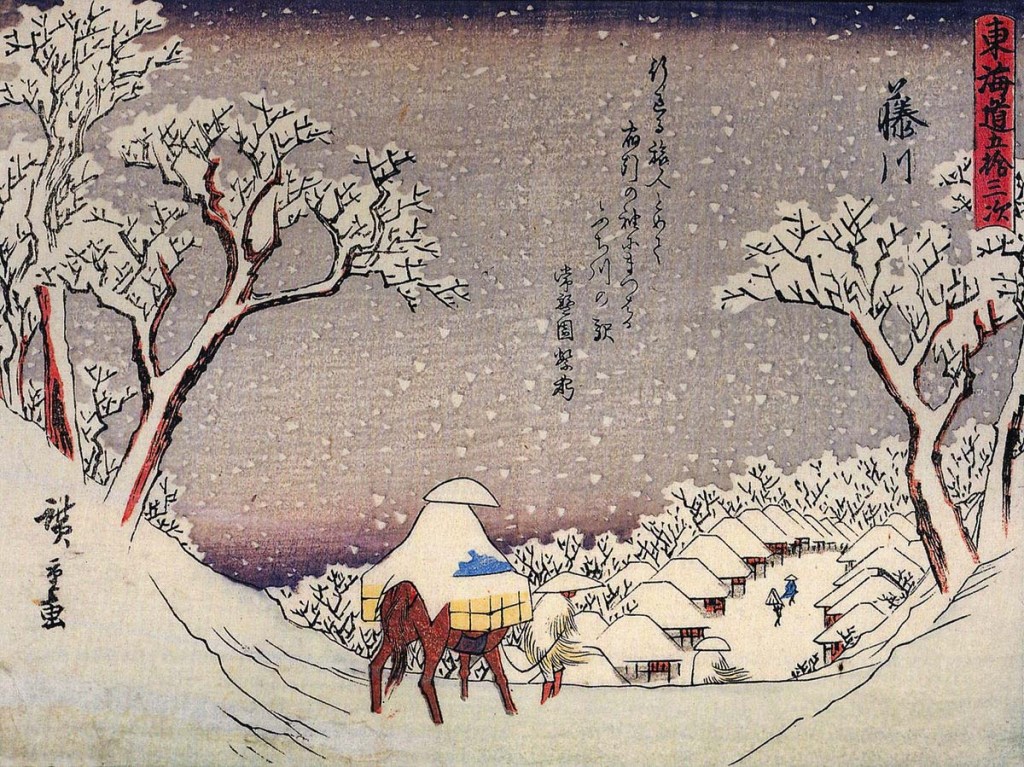
” 時は冬.” Toki wa fuyu, the season is winter. How cold is it? On cold winter days, it is not just me, even my shadow is frozen.
冬の日や馬上に氷る影法師
fuyu no hi yabajō ni kōrukagebōshi
these cold winter days on horseback — my shadow is frozen
Matsuo Basho, Oi no kobumi, Winter 1687
On the Tokaido
From Oi no kobumi, on the Tokaido, en route to Cape Irago, riding on a particularly long stretch between snow covered fields and the bitterly cold sea. Things on Basho’s mind include things from the past — Saigyo’s waka, Sogi’s renga, Sesshu’s landscape painting, and Rikyu’s Way of the Tea; those and the bitter cold.
One of the reasons for reading Basho’s haiku is that they give us “an alternative possibility of being.” (Jane Hirshfield, Seeing Through Words: Matsuo Bashō, interpreting Oi no kobumi)
Notes on Translation
Tokaido – the eastern coastal sea route from Edo to Kyoto. The 19th century artist Utagawa Hiroshige painted the 53 stations of the Tokaido.
Fuyu no hi – winter day, on cold winter days, fuyu no hiya, where ya is added for emphasis.
Koru – frozen; Kageboshi – shadow
Hiroshige, Man on horseback in snow (original image Wikipedia)
At the conclusion of his trip into Japan’s northern interior (Oku no hosomichi), Matsuo Basho rested for awhile in Ōtsu, on Lake Biwa. Places to visit include Ishiyama (Stone Mountain) whose temple, Ishiyamadera, is built on a massive formation of white stone called wollasonite. (Basho is buried in nearby Gichu-ji temple, also in Ōtsu.)
石山の石より白し秋の風 ishiyama no ishi yori shiroshi aki no kaze
whiter than stone of Ishiyama — autumn wind
Matsuo Basho, Oku no hosomichi, Autumn 1689
Shiroshi, white. In Buddhism, the transience of human life was so associated with the dew carried by the autumn wind in the early morning is called white dew — Shiratsuyu. White is also associated with purity. Ishiyamadera, the temple, is where Murasaki Shikibu began writing The Tale of Genji on the night of the full moon, August 1004.
The following year, Basho returned and lived within the grounds of Chikatsuo Shrine (adjacent to Ishiyama) in what he called Genju-an (the Unreal Dwelling). Thinking of his own mortality and because hail (arare 霰) is white, he composed this haiku.
石山の石にたばしる霰かな Ishiyama no / ishi ni tabashiru / arare kana
showering stones on Ishiyama — hailstones
Matsuo Basho, Winter 1690
Matsuo Basho had four more summers and three winters to live.
England was experiencing its Glorious Revolution. Europe was beginning its Age of Enlightenment. Japan was at peace. It was the era of Genroku 元禄. The reigning emperor was Emperor Higashiyama (東山天皇), but true power lay in the hands of Tokugawa Tsunayoshi (徳川 綱吉), the fifth shogun of the Tokugawa dynasty.
Basho’s study of Buddhism inspired the following haiku. Lightning (稲妻 inazuma) being both enlightening and ephemeral.
稲妻を手にとる闇の紙燭哉 inazuma o / te ni toru yami no / shisoku kana
lightning — a paper candle in the darkness
Matsuo Basho, Summer 1687
Note.Paper candle, an ancient means of lighting, a torch.
By the mid-1680s, Basho’s fame was established. He had left Edo for Fukagama where he lived in a simple cottage. There he taught his students and received guests. A disciple gave him a banana plant (basho) as a housewarming gift. And it was this tree that grew beside his cottage that became the symbol of the poet — fragile and, one might say, useless.
あの雲は稲妻を待つたよりかな ano kumo wa / inazuma o matsu / tayori kana
that cloud — lightning is waiting to visit
Matsuo Basho, Summer 1688
In late spring and summer of 1689, Matsuo Basho journeyed to Japan’s northern interior, following a route that took him along the eastern coast, crossing to the west coast, then traveling west and south to Osaka, returning to Edo and the Basho-an in late fall to work on what was to become his best known work (Oku no Hosomichi).
稲妻にさとらぬ人の貴さよ inazuma ni / satora nu hito no / tattosa yo
lightning — to one who understands life is precious!
Matsuo Basho, Winter 1690
Note. Tattosa 貴さ, noble and precious. Yo よ, adding emphasis.
In the summer of 1694, Matsuo Basho was 50 years old. He left Edo for the last time, spending time in Ueno, his birthplace, and then Kyoto, where he spent time as a student, before going to nearby Otsu by Lake Biwa.
稲妻や顔のところが薄の穂 inazuma ya / kao no tokoro ga / susuki no ho
lightning — in place of faces pampas grass 1694 — summer
Matsuo Basho, Summer 1694
Note. Miscanthus (susuki, commonly called pampas grass) — ever changing, from fresh green shoots in early spring to the long lasting shimmering seed-heads of autumn, a reminder of the fleeting nature of the seasons.
稲妻や闇も方行く五位の声 inazuma ya / yami no kata yuku / goi no koe
lightning deep in the darkness the sound of a heron
Matsuo Basho, Summer 1694
Note. The heron (crane) is a divine bird traveling between heaven and earth.
inazuma ni satoranu hito no tattosa yo, 稲妻にさとらぬ人の貴さよ
For Those Who Can’t Get Enough
Inazuma — etymology. 稲 ina, meaning “rice plant”, plus 妻 tsuma, meaning “spouse”. Deriving from an ancient belief that lightning mated with (fertilized) rice plants.
Compare Basho’s haiku with the Diamond Sutra (a Sanskrit text translated into Chinese during the Tang dynasty):
So you should view this fleeting world: As a drop of dew or a floating bubble in a river, As lightning flashing in a summer cloud, As a flickering lamp, an illusion, a phantom, or a dream.
Written in the 5th year of Enpo, 1678, when Matsuo Basho was 34 years old. Then known as Tosei (Unripe Peach), young Matsuo was living in Edo’s Nihonbashi District, famous for the bridge of the same name, its Noh theaters, a famous fish market, and many cafes where aspiring haiku poets like Tosei sampled their wares.
“Fuhgeddaboudit,” they sometimes say in north Jersey and New York. It means the thing is not worth one’s time or energy. Forget about it.
Fugu soup (河豚汁, fukutojiru) is made with pufferfish. Pufferfish, blowfish, it is all the same, unless you get the poisonous part. The popular fugu soup is typically prepared tableside, hot-pot style, with cabbage and leeks. Best to eat in winter. Symptoms of poisoning take a little time. So, if you wake up the next morning and feel the same as you felt the day before, you’ll be happy, thinking last night’s worries were ridiculous.
Matsuo Basho, I suspect, like most writers wrote down his thoughts on tiny pieces of paper and stuffed them into his pockets. Sometimes pulling them out, polishing the words, writing them down in a better form, publishing them. The ratio of random thoughts to published poems likely being similar to our view of an iceberg floating in the Arctic waters.
Sometimes one has one’s own random thoughts.
Random thoughts — of some importance, but never written down, are soon forgotten.
Bashō no yōna, December 2022
Anniversaries, birthdays, and Christmas, I’m often a day behind.
You layer up, wear a silly knit cap to amuse your daughter and son-in-law. They call you a “cone head” while guffawing. You put on thick mittens and add a scarf about your face. You leave.
Off you go to the park to face another day. There is beauty in the silence of the morning. Sunlight on snow, an icy breeze, the cold air you intake. There is something reassuring about another runner passing by. Something delightful about two kids trying to sled on hill that is not much more than a gully.
Sounds like fun The crunch of snow on frozen leaves — A Winter’s Run
Whoosh, whooosh, Whoosh, whooosh, … Footfalls in the snow
It Snowed last Night The World is white, This Christmas morning
On the completion of his trip to the northern interior of Japan which was to become the famous travelogue Oku no Hosomichi, Matsuo Basho took time to visit with friends and take a side journey to visit his birthplace in Ise Province. A poetry performance (renga) was held at a tea house near the castle in Iga-Ueno where Basho was once a servant.
人々を しぐれよ宿は 寒くとも
We at the inn, Even tho’ it’s bitterly cold, — Let it rain!
Hitobito wo/ Shigureyo yado wa/ Samuku tomo
Matsuo Basho, Winter, 1689
Notes on Translation
I have reversed the word order in Basho’s haiku and turned down the thermometer to bitterly cold.
To each of us at the inn, let it rain, even if it’s cold. The poets who have gathered for a renga are sitting and shivering in silence, immersed in the beautiful world of haiku. The rat-a-tat-tat of the sleet on the roof and the freezing weather creating an atmosphere of pure wabi, Buddhist term to express an emotion of subdued austere beauty.
shigureyo しぐれよ, the imperative verb form for rain, literally, let it rain. shigure, a winter rain-shower. It is a kigo for winter, and a metaphor for shedding tears.
Kenkō, 兼好 (1283–1350) Buddhist monk and author wrote this:
“It is foolish to be enthralled by fame and fortune, painfully striving all your life, and not enjoy a moment of peace and quiet.”
Yoshida Kenkō, How Will You Spend Your Last Day
By the winter of 1693, Matsuo Basho was back in Edo, again in the Fukagawa neighborhood across the frozen Sumida River, living in a simple cottage. Cottage might be an overstatement. A hut with a thatched roof that let the rain in would be a better description with buckets to catch the pattering rain.
But as it is winter, the sound of ice at night, signals the end is near.
A bottle breaks An icy night, I’m awake!
The crock cracks, I am awake, Ice at night
Awoken by The cracking crock — An icy night
瓶割るる夜の氷の寝覚め哉 kamewa ruru / yoru no koori no / nezame kana
Matsuo Basho
Notes on Translation
Kamewa ruru, 瓶割るる, the bottle breaks, the crock cracks. Not a shattering of the glass, but a slender crack that appears, like ice in a pond.
Yoru no kōri no, 夜の氷の, the ice at night.
Nezame kana, 寝覚め哉, one has the sense of suddenly being awoken from a deep sleep.
Kaba-t,カバっ, an onomatopoeic expression for waking up with a start.
A morning walk beside the creek A heavenly breeze, the rising sun Here comes the heat!
Bashō no yōna, August 2022
On the Today show, Al Roker points to a map covered in RED on the weather map. Record Heat. The days and weeks are full of sun, it’s been months since it was cool. An early morning walk with the dogs inspires Bashō no yōna’s poor attempt at haiku.
Winter 1693-94
Now, two haiku by Matsuo Basho written in early 1694. The subject, the early blooming Plum Blossom. A literary respite from the summer heat.
Fragrant plumfills the air And the rising sun on A mountain path!
梅が香にのつと日の出る山路かな ume ga ka ni notto hi no deru yamaji kana
Plum Blossom Scent, (Ume ga Ka, 梅が香), Spring 1694
Was the snow still falling? Was it bitterly cold? Did the birds sing when the sun rose?
Note. In the early spring of Matsuo Basho’s last year, he and Shida Yaba 志太野坡 composed a haiku sequence (renga) that came to be called Ume ga Ka (Plum Blossom Scent). Ume, 梅 (plum), the five petals symbolize the Five Blessings: old age, wealth, health, virtue, and a peaceful death.
梅が香に昔の一字あはれなり ume ga ka ni mukashi no ichiji aware nari
The fragrant plum, The days of old, That nothing last — ’tis a pity.
Matsuo Basho, February 1694
Note. This second haiku addressed to his student Baigan 梅丸 who had recently lost his son. Ume ga ka, the fragrant plum. Ni, a participle indicating movement or direction. Mukashi, the days of old, the past. No, acts as an indicator of possession. Ichiji. a reference to life’s impermanence. Aware, a pity, something that’s sad. Nari indicates that the emotion follows quickly.
A plum blossom fades all too soon, and so does life. Matsuo Basho died later that year.




 matsuo-basho-haiku