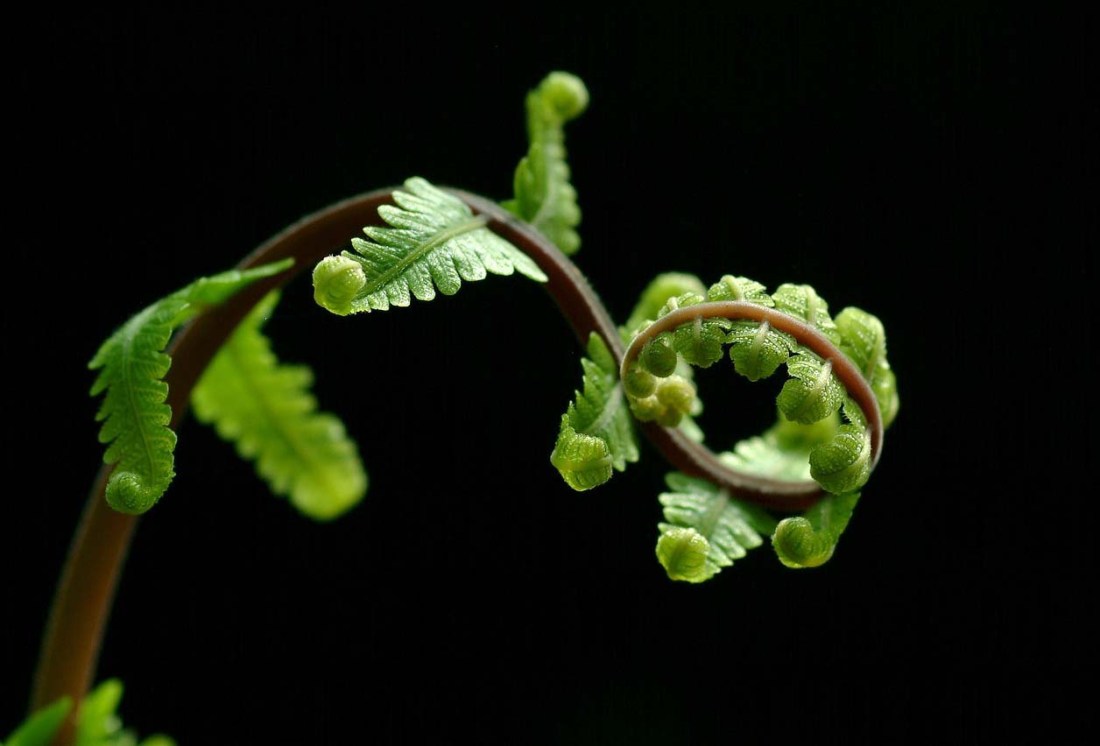
Summer Rain

Basho, age 37
8th year of Enpō, 1680

Surely, Matsuo was thinking of himself when he wrote this haiku.

In May it rains and
Ferns unfurls in light green color,
But when?

五月の雨岩檜葉の緑いつまでぞ
satsuki no ame iwahiba no midori itsumade zo

Matsuo Basho, Spring, Summer 1680

The fern becomes a metaphor for Matsuo. In May of 1680, he was not yet “Basho.” Rather, he was, to his friends and students, “Tosei,” the unripe peach. But he was about to change his color, to blossom, to ripen, to become a mature poet. First, to move to Fukagawa, then to travel, and along with the banana plant (basho) beside his simple cottage, become the beloved Basho, by which the world knows him.

But When

“But when?” or “How long?” This question Matsuo asks is personal. How long before Tosei ripens into a mature poet? How long does Matsuo stay in Edo, when other poets have struck out to explore Japan?

Notes on Translation

satsuki (May, or early Summer) no ame iwahiba (moss) no midori (of green, “midori” is the light green color of early summer, spring) itsumade (until when) zo (emphasis)

Satsuki, fifth month which in the Japanese lunar calendar makes it June or early summer

Iwahiba, a type of fern resembling cypress in appearance that turns brown in winter and with the early rain unfurls into a light green color deepening to dark green as summer comes. It grows in heavily forested mountains and secluded valleys. In drought it closes into a ball.

Itsumade, an interrogative statement meaning “until when.” There is also an old Japanese story of a scavenging bird called “Itsumade” that descends on the dead and cries “itsumade, itsumade” meaning how long until the dead and rotting corpse becomes something else.

岩檜葉, iwahiba

To Go or Not to Go

freezing monkeys

December 15, 2023
Middle America

Ten days before Christmas, the shopping is done, the house is festive, thanks to the wife. Bashō no yōna, the 21st century disciple of Matsuo Basho (aren’t we all?), has one job. Let the dog out in the morning. So, he gets up, makes the coffee, and finds the dog at the back door, looking puzzled.

It is raining outside.

It’s raining outside,
The dog’s at the door, she pauses,
To go or stay, we wonder!

Bashō no yōna, December 2023

No one likes the rain in December.

初しぐれ猿も小蓑をほしげ也
hatsu shigure saru mo komino o hoshige nari

first winter shower
(first freezing drizzle)
a monkey, it seems,
wants something to wear, like us.

Matsuo Basho, Monkey’s Raincoat, Winter 1689

hatsu (first) shigure (cold autumn/winter rain) saru (monkey) mo (too, also) komino (something to wear) o hoshige (wanting something, i.e. to wear, a raincoat) nari (also)

Monkey’s Raincoat

Baby it is cold out there.

When Basho and his friends showed up for a renga party, sometime towards the end of the year, they did so in the freezing rain wearing overcoats to protect the from the steady drizzle, (shigure).

Shigure, is that steady downfall that comes in late fall and early winter, the kind that soaks one to the bone.

Sarumino, or the Monkey’s Raincoat, is the fifth of the seven poetry anthologies compiled by Basho and his disciples. It was written in Ueno (his hometown), Kyoto and Omi, along Lake Biwa. Composed as a form of renga by Basho and his disciples and was published in 1691, three years before Basho’s death. Edited by Kyorai and Boncho.

初しぐれ猿も小蓑をほしげ也
hatsu shigure saru mo komino o hoshige nari

Source Notes.

Gabi Greve’s excellent website on all things Basho has multiple translations of the Japanese text.

The Monkey’s Raincoat online in book form by the Haiku Foundation.

Rainy Days

雨の日や

Rainy Days in Sakai-cho,
October, 1678

Enpo, 6th year, Basho is 35

Unfamiliar faces, the falling rain, autumn’s falling leaves, it’s a gray day in Sakai-cho, Edo’s theater district. Six autumns have come and gone since our poet first arrived in Edo. Uncertain about his future, even his name, for he was still called Tosei, the unripe peach.

Walking among the ghostly figures in the cold, cold Autumn rain, facing an uncertain future, what could Tosei be wondering?

Rainy days
this Autumn World
— in Sakai-cho
雨の日や世間の秋を境町
ame no hi ya seken no aki o sakai-chō

Matsuo Basho, Edo, Sakai-cho, Autumn 1678

Sakai-chô — Edo’s Kabuki Theater District (Nihonbashi) where dream-like Noh plays were the norm.

The Mortal World

Seken (世間) — this mortal world, ever becoming, ever fleeting, ghostly in its being on rainy days.

Bashō no yōna, the author of this blog, looks out his window at the falling rain, the leaves now scattered on the ground, dreaming, wondering.

Imagine. Like John Lennon said, “nothing to kill or die for, … imagine living in peace.” Sad to say, the world is at war.

It’s late October in middle America. Unlike the Carpenters’ Rainy Days and Mondays, it doesn’t have to be Monday for rainy days to always get me down. Not a light drizzle, but a steady drum-beating downpour, the kind that has the dog hiding under the bed covers.

The poet thinks of becoming and being. Being being made up of things which never change in any way, while becoming consisting of things which constantly change and existing in many ways. Being and becoming is a better way to say it.

Luck,
combining opportunity with preparation,
— good fortune

Bashō no yōna, on a theme of Seneca, October 2023
ame no hi ya seken no aki o sakai-chō

Ame

Ame, Rain
September, 11, 2023
This day will always matters

Thank goodness, it rained all day. I planted a garden two weeks ago and it hasn’t rained since then. Whether tiny sprouts pray for rain, I don’t know, but now they have no worries.

Occasionally it rained
do sprouts stop thinking,
it matters, I wonder

雨折々思ふ事なき早苗哉
ame ori ori omoufu koto naki sanae kana (1684-94 ~ summer)

Matsuo Basho, date unknown, likely spring or fall

ame (rain) ori ori (折々, occasionally) omou (what I think) koto (things that matters) naki (without) sanae (sprouts, seedlings) kana (I wonder, akin to an emoji with a puzzled look on its face)

On the 22nd anniversary of the Terrorist attack by Al-Qaeda on America and the World Trade Center.

It rained all day
on 9/11
I still stop and wonder

Bashō no yōna, September 11, 2023

The website MatsuoBasho-WKD explains that this haiku was written at a party held at the home of Taisui, 岱水, who lived close to Basho in Fukagawa. This is sourced to a book Basho’s Haiku by David Landis Barnhill. I have not found any other source to corroborate this.


Let it Rain!

Winter 1689

Let it sleet, let us freeze, … friends forever!

On the completion of his trip to the northern interior of Japan which was to become the famous travelogue Oku no Hosomichi, Matsuo Basho took time to visit with friends and take a side journey to visit his birthplace in Ise Province. A poetry performance (renga) was held at a tea house near the castle in Iga-Ueno where Basho was once a servant.

人々を しぐれよ宿は 寒くとも

We at the inn,
Even tho’ it’s bitterly cold,
— Let it rain!

Hitobito wo/ Shigureyo yado wa/ Samuku tomo

Matsuo Basho, Winter, 1689

Notes on Translation

I have reversed the word order in Basho’s haiku and turned down the thermometer to bitterly cold.

To each of us at the inn, let it rain, even if it’s cold. The poets who have gathered for a renga are sitting and shivering in silence, immersed in the beautiful world of haiku. The rat-a-tat-tat of the sleet on the roof and the freezing weather creating an atmosphere of pure wabi, Buddhist term to express an emotion of subdued austere beauty.

shigureyo しぐれよ, the imperative verb form for rain, literally, let it rain. shigure, a winter rain-shower. It is a kigo for winter, and a metaphor for shedding tears.

Another Rainy Day

Edo, Autumn, 1678, Matsuo Basho, then called Tosei, age 35.


雨の日 や世間の秋を 堺町

ame no hi / ya seken no aki o / sakai-chō

A rainy day, in Autumn the world awakens in Sakai-cho

Sakai-cho, Edo’s Kabuki Theater District, Utagawa Hiroshige

Leaving Edo

He has not yet become Bashō, 芭蕉, the poet who compares himself to the fragile and useless Banana plant. That is yet to come when, two autumns later, Matsuo Basho would take the somewhat surprising step of leaving Edo and crossing the Sumida River to Fukagawa to live in a cottage beside a Banana plant, 芭蕉.

For now, Basho enjoys Kabuki Theater. Rain doesn’t matter. Perhaps it heightens the surreal quality of the plays.

Kechi, Kansas, Autumn, 2021

More than three centuries have gone by since Matsuo Basho wrote his haiku.

Today, in 2021, pubs and micro-breweries have become the gathering place for friends and couples who want to talk about the day’s events, about the World.

It is another rainy day in Middle America. It is early September; the summer’s heat has given way to cooler days and nights. The author of this blog takes a trip to Kechi, a small Kansas town outside Wichita. He is accompanied by his wife and dog, Lucy, a small dog, a mix, mostly Blue Heeler. The three of us sit on the patio under trees strung with lights, sample the beers, listen to music, and forget our worrries.

Suddenly, it starts to storm. Lucy runs inside and shakes off the rain. Bashō no yōna, the author of this blog, and modern day Basho disciple, says this:

A dog knows
To Stay out of the Rain
And Sakai-cho

Beer stops Pouring
When it starts Raining

At the Old School House in Kechi

Notes on Translation

Before becoming Basho, Matsuo Basho took the pen name Tosei, 桃青, meaning “green peach” inferring that he was not quite ripe.

世間, Seken, literally the World, Society, as opposed to the individual. According to the Buddha, there are two worlds, the internal world and external world. Through meditation, one understands one’s thoughts and feelings, and finds one’s ‘inner world’.

境町, Sakai-chō, literally border town. It is somewhat unclear whether 境町, Sakai-chō is a place within Tokyo’s Nihonbashi District, or it merely borders it, a special district where Kabuki Theaters were allowed. Often these theaters began in Tokyo where prostitutes plied their trade. Other worldly in this sense takes on a sexual connotation. Though frowned upon by the ruling authorities, such districts were allowed. William Shakespeare and the Lord Chamberlain’s Men similarly had to obtain a royal license to perform.

Gabi Greve has given us a thorough discussion of Nihonbashi in her thoroughly wonderfully blog.

Previously translated as Rainy Day and Seken no Aki.

Historical Context

England 1678, John Bunyan published The Pilgrim’s Progress, an other worldly allegory of man’s journey through life. Japan was under the rule of the Tokugawa shogunate and culturally isolated from Western societies.

Does Your Roof Leak

Spring rain –
running down a wasp’s nest
from a roof that leaks

春雨や 蜂の巣つたふ 屋根の漏り

harusame ya     hachinosu tsutau      yane no mori

Wasp Nest, Kono Bairei, 1844-1895

More rain

Yesterday, it rained. Today, it rains again. Tomorrow, it is suppose to rain again. I should look around the house to see if the roof leaks. Is it not a fundamental principle of life, Basho asks, that a roof shall leak?

For Matsuo Basho the steady drip of the rain from a wasp’s nest became the subject of this haiku. Does this not remind you, Gentle Reader, of the premise of the television show Seinfeld — “a show about nothing” and everything. Observational comedy like haiku poetry are based on everyday phenomenon rarely noticed. Have you ever noticed? — a wasp nest shouldn’t leak.

Cosmic principles

To make the point, Basho ends this simple haiku with the Japanese character り, Ri, which in Confucian philosophy attempts to identify an underlying principle of the cosmos — a roof shouldn’t leak, but it sometimes does, but not in a wasp nest.

Notes on Translation

Harusame, 春雨 is Basho’s oft repeated Spring Rain. Hachinosu, 蜂の巣, a wasp nest or beehive. Also, a colloquialism for something full of holes, like Swiss cheese, a knit scarf, and Basho’s roof. Yane no mori, 屋根の漏り, a roof that leaks.

Rain and More Rain

a rainy evening

spring rain, summer rain, autumn rain, winter rain
it’s really all the same –
wet

春の雨夏の雨秋の雨冬の雨
すべて同じ
湿潤

Haru no ame natsu no ame aki no ame fuyu no ame
Subete onaji
Shitsujun

Maybe, to a duck, rain is all the same throughout the year. To me it’s icy cold or hot. Bashō no yōna.

Occasionally posting as Bashō no yōna, which seems like an oxymoron, no yōna, like but no like.

An Early Summer Rain – Samidare no

An early summer rain
Falling on this and that
And the Temple of Light

An early summer rain
Does not dim
The Temple of Light 

Samidare no/ Furinokosite ya/ Hikari-do

五月雨の 降のこしてや 光堂

rain-lights

May, 1689

It is an early summer rain in Kansas, some three hundred thirty one years since Matsuo Basho wrote this haiku. At the time, Basho and his traveling companion Sora were on the famous Journey to the North. Visiting Hiraizumi, Basho would have taken the pathway on Tsukimi-zaka slope to Chuson-ji Temple and its golden hall of Hikare-do (Konjiki-do).

[Note on translation. Furinokosite ya, 降のこしてや. The second line of the haiku is a turn of a phrase. The first character in the line indicates a fall, as in the rain falling, but also to subdue, to lessen or decrease in stature, hence the verb “dim”.]

Prior translation

Yoshitsune

Basho had come not only to see Hikare-do, the Temple of Light dedicated to the Buddha, but also to reflect on the the rise and fall of the northern Fujiwara clan, and the tragic end of the samurai Yoshitsune, an event that took place some five hundred years previously.

Of Yoshitsune, Basho wrote another well-known haiku; one that seems to express a contrasting emotion.

The summer grass is all that remains of  a warlord’s dreams.

Natsukusa ya / tsuwamono domo ga / yume no ato.

Autumn Gales

Banana tree in a fierce autumn gale
I wonder if I can hear
Rain in the tub, tonight!

Bashō nowaki shite
Tarai ni ame o
Kiku yo kana

芭蕉  野分   して盥に雨を聞く夜哉

Autumn 1681

In the winter of 1680 Bashō moved  from central Edo across the Sumida River to the rural Fukagawa district. His patrons and disciples had prepared a cottage with a thatched roof for him in the midst of a grove of banana trees. In the spring of 1681, one disciple gave him a house warming gift, a new banana plant (Bashō, hence the name Bashō-an).

Away from the distractions of Edo, Bashō had more time to collect his thoughts and compose haiku.

Summer came, and then fall, and with fall the fierce storms and typhoons that strike Japan every year.

Bashō’s Explanation

A sleepless Basho composed the above haiku. Alone, he was wondering if he could withstand the night. Bashō’s explanatory notes provide some insight:

Sleeping alone in a thatched hut

The elder Du (Fu) wrote a poem about a thatched hut blowing (tearing) in the wind. Then the old man Su Shi wrote verse about a leaking cottage. Now I listen to their rain pounding my banana leaves, lying alone in my thatched cottage.

Du Fu is a poet of the Tang dynasty, much admired by Basho. The poem he refers to is Song of My Cottage Unroofed By an Autumn Gale. Du Fu’s poem is much longer, and more involved, but it begins much like Basho’s haiku:

“In the eighth month, autumn’s fierce winds angrily howl,
And sweep three layers of thatch from off my home.
The straw flies over the river, and scatters,
Some hangs high up in the tree,
Some floats down and sinks in the ditch…”

Some three centuries later, Su Shi of the Song dynasty composed a poem with a similar thought, “My thatched roof torn by the autumn wind…”

banana-trees