On the First of April, 1680, Basho visited the Ishiyama-dera Temple, in Otsu, at the southern end of Lake Biwa. This is where Murasaki Shikibu is said to have written the tragic Tale of Genji.
Who has not risen at dawn to watch the sunrise. In the lingering lavender just before the sun rises, to hear the winsome cry of a lone bird telling a tragic tale.
it is not yet dawn, in the lingering lavender sky, — a cuckoo calls
曙はまだ紫にほととぎす akebono wa mada murasaki ni hototogisu — Matsuo Basho, April 1, 1860
はまだ (wa mada), it is not yet
紫 (murasaki), purple, and its many shades, including lavender.
Matsuo Basho would hurry back to Edo where he prepared to move across the Sumida River to the rural Fukagawa District. This move would foretell the poet’s renaming as Basho when a disciple gave him a banana plant as a housewarming gift.
[Note. 風羅, literally, the wind that shifts; 坊, monk. Basho idolized Saigyo, a 12th century monk who wandered.]
The thought first appeared to Matsuo Basho in Oi no Kibumi (1688). That he, Matsuo Basho, like Saigyo, had become a wanderer with no fixed home. Furabo appears in the introduction, in the first line.
百骸九竅の中に物有、かりに名付て風羅坊といふ。 “Somewhere within my body of 100 bones and 9 orifices is something I call Furabo (風羅坊).”
The thought became an idea that reappeared not too far into Basho’s Journey into the Northern Interior (Oku no Hosomichi, 1689). Basho and his companion Sora spent a couple of days in Nasu, at the home of Takaku Kakuzaemon, the village headman. The village had hot springs which must have come as a relief to the two travelers. Nearby were several volcanic mountains, and a place called seessho-kiki, the killing rocks, so named because the sulfuric fumes were poisonous. Perhaps, Basho heard the familiar sound of the cuckoo bird, “kakkou kakkou” and compared that to the name of his host, Takuku. Taking this call as a warning to “rest.”
Basho wrote, 落ち来るや高久の宿の郭公.
ochikuru ya | falling down from high takaku no shuku no | at Takaku’s inn hototogisu | a cuckoo bird
Matsuo Basho, Oku no Hosomichi, Nasu, Summer 1689
and signed his name as Furabo.
If Basho was thinking of changing his pen-name to Furabo, it was too late.
The cuckoo is considered a lazy bird, a clever bird, whose rhyming call gives it its western name — kyo, kyo. Cuckoos are brood parasites, meaning their young are raised by other birds.
Therefore, much like a poet.
There is also the familiar story of the warlords Oda Nobunaga, Toyotomi Hideyoshi, and Tokugawa Ieyasu who said:
Oda Nobunaga: 鳴かぬなら殺してしまえ時鳥 nakanu nara koroshite shimae hototogisu, if the cuckoo does not sing, kill it.
Toyotomi Hideyoshi: 鳴かぬなら鳴かしてみしょう時鳥 nakanu nara nakashite mishō hototogisu, if the cuckoo does not sing, coax it
Tokugawa Ieyasu: Nakanu nara naku made matte miyou hototogisu 鳴かぬなら鳴くまで待ってみようホトトギス if the cuckoo doesn’t sing, wait until it does.
Cuckoos
Soon after completing his epic journey to the northern interior (Oku no Hosomichi), Basho remembered his student days in Kyoto and wrote:
Even in Kyoto, one yearns for the cry “kyoo-kyoo” and the cuckoo Kyoo nite mo, Kyoo natsukashi ya, hototogisu 京にても 京なつかしや 時鳥
Matsuo Basho, 1690
Here is a sampling Matsuo Basho’s haiku beginning with 時鳥 and ほととぎす and its variations — hototogisu (cuckoo).
hototogisu / ima wa haikaishi / naki yo kana the cuckoo sings and the world has no poets 時鳥鰹を染めにけりけらし
It is a common belief that the cuckoo vomits blood. Bonito or Skipjack Tuna are a popular fish in Japan with a deep red color.
hototogisu / katsuo o some ni / keri kerashi the cuckoo stains the Bonito fish I suppose 時鳥鰹を染めにけりけらし
hototogisu / kie yuku kata ya / shima hitotsu a cuckoo flying to an island becoming one thing ほととぎす消え行く方や島一つ
hototogisu / koe yokotau ya / mizu no ue the cuckoo flies, singing, stretching out, on the cold water lies 郭公声横たふや水の上
hototogisu / maneku ka mugi no / mura obana a cuckoo invited by barley and its waving fronds 郭公招くか麦のむら尾花
hototogisu / matsuki wa ume no / hana sake ri the cuckoo and plum flowers in June, both have bloomed 時鳥正月は梅の花咲けり
hototogisu / naku naku tobu zo / isogawashi The cuckoo, crying, singing, flying, oh, so busy ほととぎす鳴く鳴く飛ぶぞ忙はし
The following haiku makes sense if one imagines that Basho’s writing box (suzuri-bako, 硯箱) has the image of a singing cuckoo on the lid.
hototogisu / naku ne ya furuki / suzuri-bako the cuckoo singing in a tree and on my writing box 杜鵑鳴く音や古き硯箱
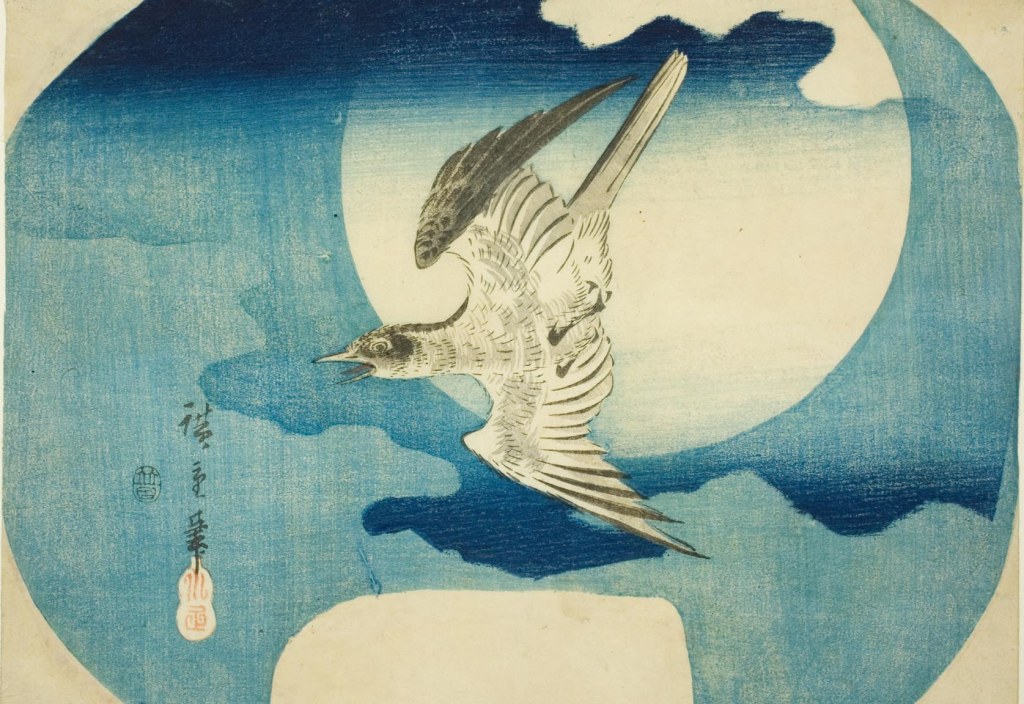
The following haiku is unclear to me. Is the cuckoo in a patch of irises five feet wide, or perched on a five foot tall iris? The later 18th century artist Utagawa Hiroshige (歌川 広重) drew a picture of a cuckoo flying above a tall iris suggesting the later.
hototogisu / naku ya go shaku no / ayamegusa a cuckoo crying above a five-foot iris. ほととぎす鳴くや五尺の菖草
hototogisu / ō takeyabu o / moru tsuki yo a cuckoo in a bamboo grove on a moonlit night ほととぎす大竹薮を漏る月夜
In 1689, on the journey north (Oku no Hosomichi), Basho visited the waterfall Urami-no-Taki, so named because one could walk behind the cascading falls. The rhyming words “urami” and “ura omote” coming to mind. The suggestion, I suppose, that one has a private face and a public face. Sometimes we have to hide to see reality.
“For a while I hid under the waterfall at the start of the Summer Retreat.”
hototogisu / Urami-no-taki no / ura omote a cuckoo as seen behind the waterfall, back and front ほととぎす裏見の滝の裏表
For additional Basho haiku on the cuckoo and alternate translations and comprehensive explanations see:
Even in Kyoto Longing for Kyoto Hearing the Cuckoo
Even in Kyoto Nostalgia for Kyoto – the Cuckoo
Summer, 1690
By Japanese reckoning it was the era called Genroku (元禄, meaning “original happiness” or perhaps “the beginning of happiness”). It was the third year of the reign of Emperor Higashiyama, 113th emperor of Japan.
That spring Matsuo Basho had completed his trip that would become in time his most famous travelogue, Oku no Hosomichi, Journey to the Far North. Not wanting to hurry back to Edo, where Basho had lived and written for the last 46 years, he decided to stay in Kyoto for four months in a modest hut called Genjuu-An 幻住庵, located on the grounds of the Chikatsuo Shrine.
Summer was approaching. In Kyoto’s trees, now full of green leaves, one could hear the plaintive cry of the cuckoo, “Kyoo-Kyoo.” Basho recalled his early days a student in Kyoto.
Matsuo Basho was 56 years old. Basho’s own death came in 1694.
Japanese and Pinyin
京にても 京なつかしや 時鳥 Kyoo nite mo, Kyoo natsukashi ya, hototogisu
Notes on translation
京 Kyoo, Kyoto, appearing at the beginning and repeated to imitate the sound of the cuckoo bird. Some say the birds call, “kyoo-kyoo,” is the cry of the dead longing to come back.
なつかし natsukashi, a feeling of nostalgia, a joy for the remembrance of the past. I have used longing.
時鳥hototogisu, The cuckoo bird. Basho leaves us with the image of a cuckoo bird and nothing more. Nothing else was needed since the cuckoo was a frequent subject of poets.




 matsuo-basho-haiku