“Winter is coming.” It’s all over the news. It’s January, I wonder what to do in the midst of a storm. Let’s stock up on a few winter haiku by Matsuo Basho.
Winter is coming Oh, there is snow on the way, The weatherman says
A monkey caught unawares by the snow and the sleet.
初しぐれ . 猿も小蓑を . ほしげ也 hatsu shigure . saru mo komino o hoshige nari
The first time it snows even a monkey know what he wants — a little straw coat.
Out for a ride, after a blizzard, I want to go home but I’m stuck to my seat.
冬の日や. 馬上に氷る . 影法師 uyu no hi ya . bashō ni kōru . kagebōshi
It’s a wintry day I sit on a horse, frozen, along with my shadow.
Just when we think, winter’s over …
初雪や . 水仙の葉の . たわむまで hatsuyuki ya . suisen no ha no . tawamu
The season’s first snow dumped on a daffodil leaf — bending, it bows.
To most children, the snow is pretty, to some it’s sad.
霜を着て . 風を敷き寝の . 捨子哉 shimo o kite . kaze o shiki-ne no . sutego kana
All covered in frost, laying down in the wind, asleep — an abandoned child.
The snow is pretty Some children make snow angels, As some fall asleep
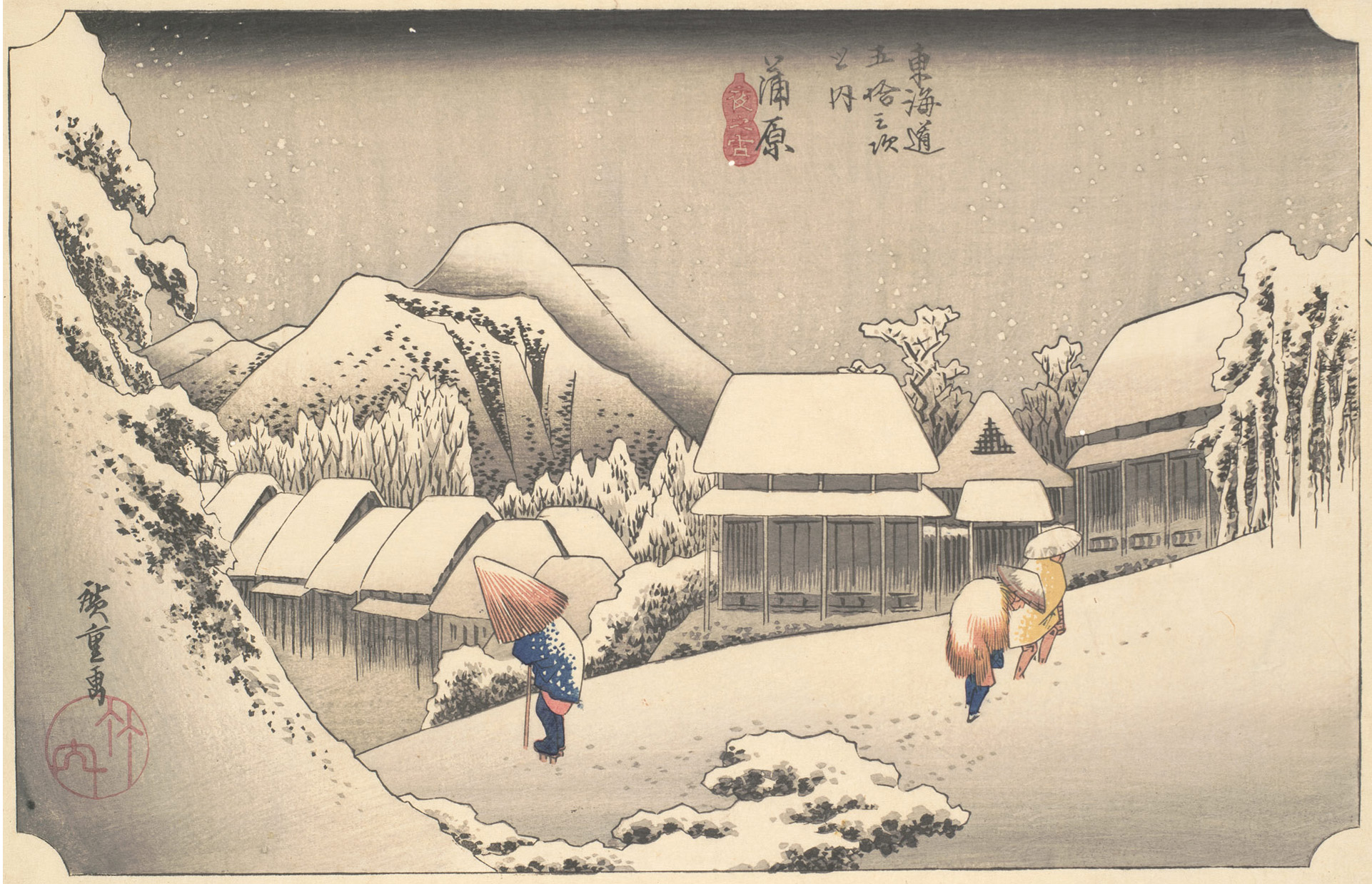
Snow and more snow, On this December night Is there somewhere a bright moon?
Snowing This winter’s night So much for the full moon
Yuki to yuki/ Koyoi shiwasu no/ Meigetsu ya
Matsuo Basho, Wandering south towards Kyoto, Winter 1684
Hiroshige (1797–1858), Meguro Drum Bridge
Winter’s Night, 1684
In the Japanese calendar, the Japanese refer to the 12th lunar month as shiwasu. At a renga party where poets compete to form haiku with complementing verses, not everyone has arrived. Meanwhile, the conversation centers on the snowy weather and who is late.
Should they start reciting haiku? After all, there is a lot to do before the Lunar New Year arrives.
Matsuo Bashō begins:
I run, you run, the days are brief, so we all run, shiwasu, even the priests run to complete their tasks.
Snow and more snow, On this December night Is there a beautiful bright moon?
Notes on English translation
Yuki to yuki (雪と雪) snow and more snow, snow upon snow, something approaching a blizzard.
Koyoi (今宵) tonight, this evening
Shiwasu (師走の), the 12th lunar month, December. Literally, it means “priests run”, implying that even Buddhist monks and Shinto priests also have to run around, as they are very busy for the yearend. Shiwa (師走) may also refer to a teacher or master, meaning that Bashō is also running at this time of year.
Meigetsu (名月) often refers here to a bright moon or to a full moon, which according to the old Japanese lunar calendar, appeared on the fifteenth night of each month. This is similar to the Roman “ides”, marking the first appearance of the full moon.
First Snow falling on the unfinished bridge, Oh, if only on top
わからない, Wakaranai, I don’t understand
“Master Basho,” the disciple says after reading this haiku, “Wakaranai, わからない, I don’t understand.”
After a momentary pause, Master Basho replies, “Those who speak, do not know. Those who know, need not speak.”
The disciple bows his head, the fingers of his two hands interlaced in his lap, and exhaling a deep breath before repeats, almost as if in prayer, “Wakaranai.”
The old master removes his cap and runs his hands through his graying hair. Then he strokes the beard of his chin as if it were the fur of a cat and says, “We are all looking for answers. But some things in life are mysteries. There are no answers my son. Perhaps, a haiku, a word picture may suffice.”
After a moment, the disciple nods.
Unexplainable, unknowable, ineffable
Even the most gifted writers know than not all experiences can be rendered into language. A common example, the first light of the morning sun parting the darkness greeting the new day. “You had to be there,” one usually says when trying to describe the unexplainable, the unknowable, the ineffable.
Matsuo Basho’s haiku is inspired by the building of the lofty Shin Ohashi (New Great Bridge). Constructed in the fall of 1693, it spanned the Sumida River, and for the first time linked the bustling city center of Edo (old name for Tokyo) and rustic Fukagawa, where Basho lived in a hut provide to him by his disciples. One source reports that the construction was begun “in July and finished in five months on Dec. 7 1693.” (See the online essay, The Spaces of Robert Hass, March 10, 2015, James Karkoski). If so, it still allows time for the a first winter’s snow before the bridge’s completion, a moment for Matsuo Basho to stand below the unfinished bridge.
Although it depicts rain and a completed bridge, this later day painting by Japanese artist Hiroshige, 1857, conveys a sense of being exposed to the Nature’s elements.
Hiroshige Atake, Shin Ohashi bridge, Shizuoka city Tokaido Hiroshige Museum of Art
Lost in translation
Translators rarely agree about wording and Matsuo Basho’s poem is no exception.
The most Spartan example by David Landis Barnhill:
first-snow ! / make / bridge ’s top
Robert Hass:
first snow
falling
on the half finished bridge
This last example seems to eliminate the last line of Basho’s poem, の上に, no ue ni, which I render as “If only on top” and adding the gratuitous exclamation “Oh”.
One might add a little more context to the haiku by explaining that Basho moved from Edo to Fukagawa in 1680. The river Sumida separated the two and there were no bridges. I suspect that not all of the residents would look forward to becoming a part of metropolitan Edo (Tokyo).
Understanding and knowing
One has to wonder if there is a difference in Japanese between understanding and knowing. My answer is: わかりませんです, Wakarimasendesu.
First snow and
the daffodils leaves bend
to nothingness
First snow
the daffodil leaves bend
barely
初雪や
水仙の葉のたわ
むまで
hatsuyuki ya
suisen no ha no tawa
mu made
The prompt
Today we call them prompts. A word or a phrase that elicits a response.
The prompt is followed by an attempt to sketch a scene in a few words. The goal is to capture the pure essence of an action or emotion. Matsuo Basho and his disciples used such devices to write haiku. From Basho’s frequent use of 初雪や, hatsuyuki ya, or “first snow and” in Basho haiku, we learn that snow was often the subject. There are for example first snow and the great Buddha, first snow and the crow, and many others, including the one above about daffodils.
Daoism teaches us the paradox of the Way – those who know do not need to speak to show that they know.
How to say a lot in a few words
Haiku are meant to be self-explanatory. Like a sunset or a rainbow, the smile of child, the smell of spring, the first snow of the year when the daffodil has already bloomed.
If not, they should be rewritten. For this reason, Basho often rewrote haiku if he found that it was misunderstood by the common people that he associated with. I apologize for using the term “common people”. It is not a term Basho was likely to use. He was the great equalizer, recognizing that we all have value, that we are all struggling to understand the life we live and find our way in this world.
Knowing the unknowable
Having said that no explanations should accompany a haiku, I will nevertheless try to explain this one as I see it. Others have, sometimes ad nauseum, why not me?
First of all, it is important to understand that “first snow” means the first snow of the lunar New Year. Better to think of this as an early snow in March, one that accompanies the blossoms of the cherry trees, or the flowering of daffodils. When winter has been to soon forgotten…
Next, understand that, although Basho has only spoken of the leaves of the daffodil and not the flower, he is intending both. We learn this from a painting Basho later made to go with the haiku, on that displayed the white daffodil flower drooping in the white snow.
Finally, we are presented with the Kireji (切れ字, “cutting word”), the final three characters, むまで, mu ma de, literally “to the utmost”. The conundrum, which Basho intended, is that a literal translation does not capture the true meaning. Basho uses the character む, mu, which is intended to be an indefinable nothingness.
How Zen…
Words do not help.
Instead we are left with the vision – daffodils struggle with the weight of the snow bent until blossom and snow become one.




 matsuo-basho-haiku